
Glass processing presents unique manufacturing challenges. The material possesses high light transmittance and high surface reflectivity. When a glass router machine mills or cuts the material, it leaves behind microscopic edge defects.
These micro-cracks and tiny edge chips typically measure in the micrometer range. Finding them requires highly specialized optical equipment. Relying on standard consumer-grade lenses leads to false rejects and missed defects.
Choosing the wrong optical lens does more than just cause inspection errors. An incorrect working distance can lead to direct collisions between the lens and the high-speed spindle. It can also expose sensitive optics to cutting fluids, lowering the overall equipment effectiveness (OEE) of your entire production line.
At Jinyuan, we understand how vital precision optics are for your automation systems. We regularly help process engineers and quality managers in automotive and 3C electronics factories optimize their visual inspection setups.
This article breaks down the five critical optical parameters you must evaluate when selecting a vision inspection lens for a glass router machine. We will look at these parameters from a strict B2B manufacturing perspective to help you improve your machining yields.
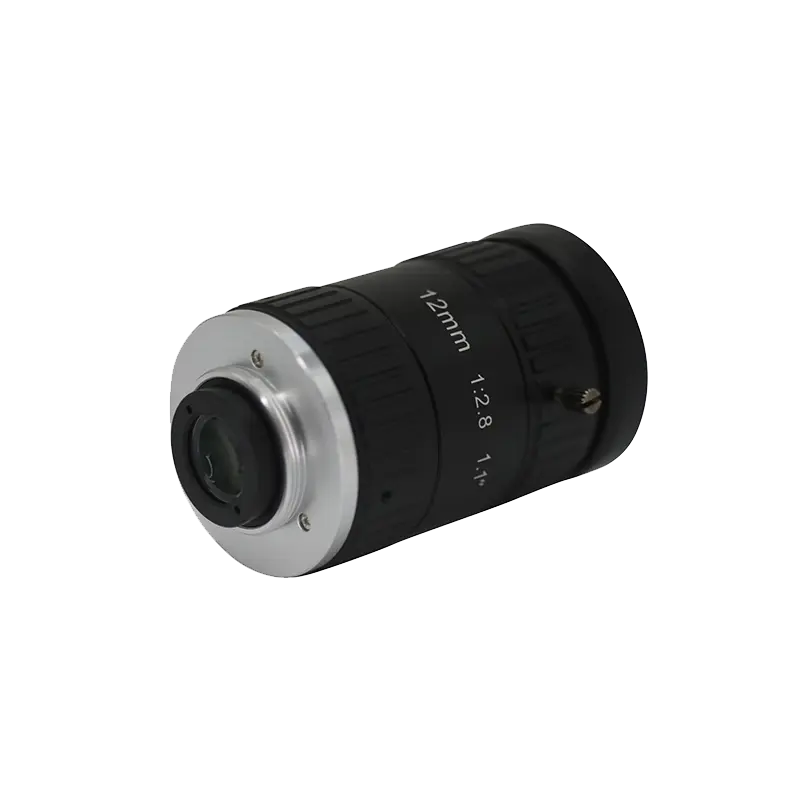
1. Telecentricity: Eliminate Thickness Errors and Perspective Distortion
Cover glass used in mobile phones and automotive displays always has a specific thickness tolerance. When you place a standard lens on a glass router machine, it suffers from perspective error. Objects closer to the lens appear larger, while objects further away appear smaller.
This "parallax error" causes major problems during the routing process. Even a slight vertical bounce or thickness variation on the glass surface changes the measured dimensions on the screen. The machine vision software receives inaccurate data, which directly alters the CNC tool path.
To fix this, process engineers must select a bi-telecentric lens. This specific type of optics maintains a constant magnification across its entire depth of field.
With a bi-telecentric lens, the dimension of the glass remains perfectly stable even if the material moves slightly along the Z-axis. This optical stability ensures the routing path stays perfectly aligned, completely eliminating parallax-induced machining errors.
2. Working Distance (WD): Balance Safety and Machining Clearance
The internal environment of a glass router machine is hostile to delicate electronics. The machining process involves high-speed spindle rotation. It also requires a constant, heavy spray of liquid coolants and cutting fluids to prevent the glass from shattering.
Your optical lens must survive right next to this aggressive milling process. If you specify a lens with a short working distance, you place the camera dangerously close to the cutting area. This increases the risk of contamination from coolant splash.
A short working distance also creates mechanical interference. Modern CNC glass machines require frequent automated tool changes. A bulky lens positioned too close to the glass will eventually collide with the moving spindle.
Recommended Working Distance Metrics
Specify a working distance of at least 110mm to 150mm.
Ensure enough physical space remains for splash guards and protective enclosures.
Leave room for automated air blowers that clear coolant off the glass before the camera triggers.
Verify the clearance path of the spindle during its return-to-home sequence.
By maximizing the working distance, you protect your costly inspection hardware while keeping the machining area totally clear for mechanical movements.
3. Optical Resolution and Contrast (MTF): Catch Micro-Level Chipping
Manufacturers of automotive displays and smartphone screens demand flawless edges. The quality standards typically require the detection of micro-cracks and edge chipping smaller than 10 micrometers.
Many system integrators make the mistake of buying industrial cameras with massive megapixel counts, hoping this will solve their inspection problems. However, a high-resolution camera is useless if the lens cannot resolve the fine details.
You must evaluate the lens based on its Modulation Transfer Function (MTF). The MTF curve tells you how well the lens transfers contrast from the subject to the image sensor at a specific spatial frequency.
To capture semi-transparent micro-cracks on a glass edge, the optical resolution of the lens (measured in line pairs per millimeter, or LP/mm) must match the pixel size of your industrial camera. If the lens cannot resolve the light bouncing off a tiny chip, the defect simply blurs into the background.
4. Optical Distortion: Guarantee Absolute Precision in Large-Format Routing
Modern glass manufacturing prioritizes high throughput. A contemporary glass router machine often performs multi-cavity processing. It machines several small glass pieces simultaneously or routes a single, massive piece of automotive dashboard glass.
When measuring across a large field of view (FOV), optical distortion becomes a severe threat to accuracy. Standard lenses suffer from barrel or pincushion distortion. They warp the image slightly at the outer edges of the frame.
If your lens has a distortion rate higher than 0.1%, the physical coordinates assigned to the edge of the glass will be wrong. Software engineers often try to fix this by applying heavy digital calibration algorithms.
However, running complex distortion correction software takes processing power. It adds milliseconds to every inspection cycle, which slows down the entire machine. To maintain a fast cycle time, you should prioritize an ultra-low distortion lens.
Selecting an optical lens with a distortion rating below 0.05% guarantees absolute physical precision across the entire glass sheet. It relieves your software of heavy computation, allowing the glass router machine to operate at maximum speed.
5. Depth of Field (DOF) and Wavelength Coating
Glass routing is not strictly a two-dimensional process. The machine often cuts a chamfer or a bevel along the edge of the glass. These 3D features require a lens that can keep multiple depth planes in sharp focus simultaneously.
If your lens has a shallow depth of field, the top edge of the chamfer might be sharp, but the bottom edge will be blurry. This blur makes it impossible to measure the exact angle and width of the routed bevel.
You must calculate the correct aperture (f-number) to secure a deep enough depth of field. However, narrowing the aperture reduces the light entering the camera. You must balance this by using powerful, specialized illumination.
The Importance of Optical Coatings
Glass surfaces cause intense glare and specular reflection. This flare blinds the camera sensor.
Select lenses with specialized anti-reflective coatings.
Match the lens coating to the specific wavelength of your lighting system.
Use high-penetration short-wave blue light or infrared (IR) light to bypass surface reflections.
Ensure the optical coating maximizes transmission for that exact wavelength.
By mastering depth of field and wavelength optimization, your vision system will reliably inspect complex glass bevels without being blinded by surface reflections.
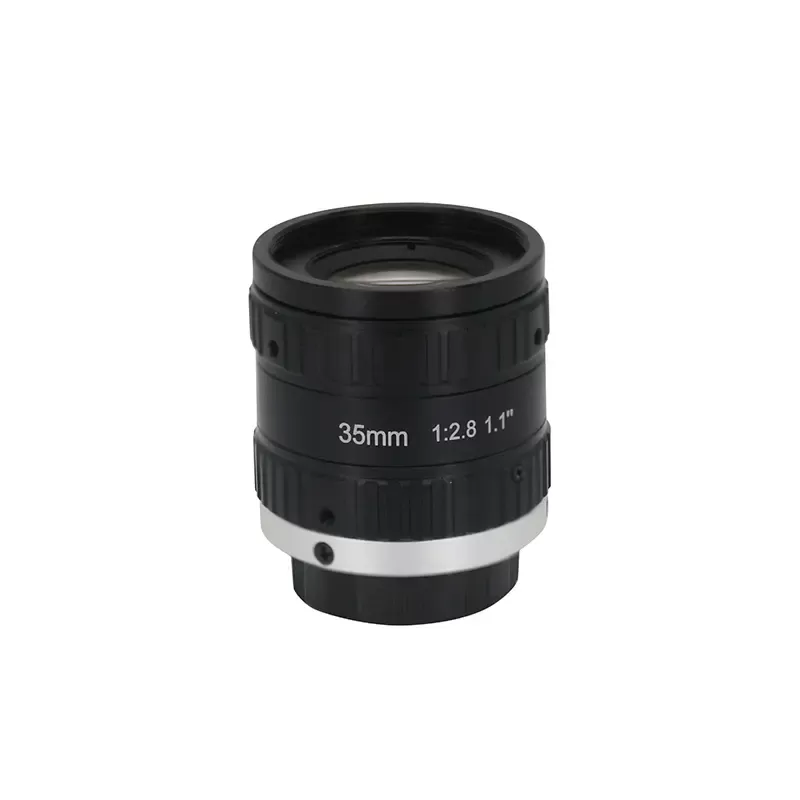
Environmental Protection and ROI Considerations
The environment inside a glass processing facility demands rugged hardware. Glass dust is highly abrasive. When mixed with cutting fluids, it creates a damaging slurry that ruins unprotected equipment.
Any lens installed on a glass router machine must feature a robust housing. We highly recommend specifying lenses with an IP65 or IP67 rating to guarantee complete dust and water resistance. Furthermore, the constant vibration from the high-RPM spindle requires the lens elements to be securely glued and locked in place.
As experts at Jinyuan often point out, investing in high-quality optics brings a rapid return on investment. Premium bi-telecentric lenses might carry an initial cost 20% to 30% higher than standard lenses.
However, this hardware upgrade can easily push your machining yield from 95% to 99.5%. By eliminating false rejects and preventing spindle collisions, a single production line usually recovers the cost difference of the premium lens within the first six months of operation.
Frequently Asked Questions (FAQ)
Q1: Why can't I use a standard prime lens on my glass router machine?
A1: Standard prime lenses suffer from perspective distortion. When the glass thickness varies or vibrates, the physical dimensions appear to change on screen. This parallax error feeds incorrect coordinate data to the CNC tool path, ruining the machining accuracy.
Q2: How does working distance affect machine safety?
A2: A glass router machine uses high-speed moving spindles and heavy coolant sprays. A short working distance places the lens in the collision path during automated tool changes. A longer working distance (over 110mm) provides safety clearance and room for protective splash enclosures.
Q3: What light wavelength works best with inspection lenses for glass?
A3: Short-wave blue light or specific ultraviolet (UV) wavelengths perform exceptionally well. They scatter effectively on microscopic cracks and edge chips. Ensure your lens has optical coatings optimized to transmit these specific wavelengths without creating internal glare.
Q4: Does depth of field matter if I am only cutting flat glass?
A4: Yes, because most flat glass undergoes edge chamfering or beveling. These edge treatments create a three-dimensional slope. A shallow depth of field will blur the bottom of the chamfer, preventing accurate measurement of the routed angle.
Q5: How do I calculate the required optical resolution for my system?
A5: You must look at the pixel size of your camera sensor. Calculate the Nyquist frequency based on that pixel size. Then, review the lens's MTF chart to ensure it maintains high contrast (usually above 20-30%) at that specific spatial frequency (LP/mm).
Optimize Your Glass Machining Yields Today
Achieving perfect edges in glass manufacturing requires a precise alignment of mechanics, software, and optical hardware. By prioritizing telecentricity, proper working distance, matching MTF, low distortion, and the correct depth of field, you ensure your equipment performs flawlessly.
Do not let substandard optics create a bottleneck in your production facility. Jinyuan provides industry-leading expertise in precision machining and optical integration.
Ready to eliminate edge chipping and improve your production efficiency? Download our "Glass CNC Machining Vision System Selection Calculator" to spec your next project.
Alternatively, contact our optical engineering team today to customize a dedicated vision optimization plan for your current glass router machine.