
The progression of video surveillance from analog resolution to multi-megapixel performance has shifted how optical components are selected. Standard security cameras rely on a precise synergy between the image sensor and the optics focusing light upon it. Board lenses, commonly utilizing the M12 mount standard, are key drivers of this performance in compact systems. Selecting a compatible Hd Board Lens Cctv is a primary step in constructing reliable security hardware. As industry requirements demand smaller form factors alongside higher resolutions, understanding the optical engineering behind these compact lenses is necessary for product developers and system integrators. Jinyuan provides tailored optical designs that align with these demanding specifications.
The Mechanical and Optical Anatomy of a Board Lens
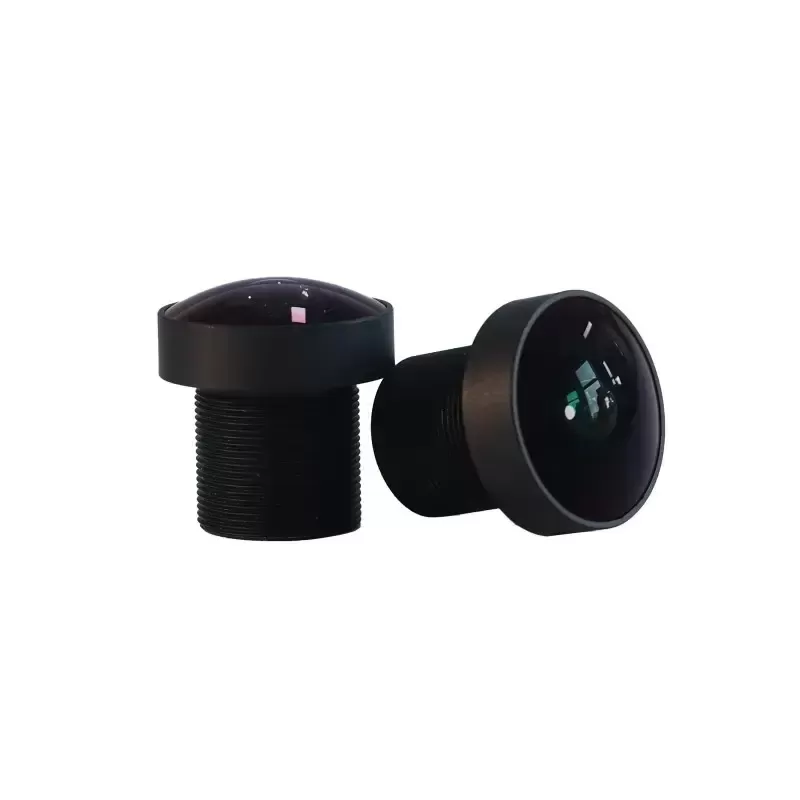
A board lens is characterized by its compact design and fixed focal length, designed to screw directly onto a threaded holder mounted on a printed circuit board (PCB). This design eliminates the bulky mechanical housings found in varifocal or motorized lenses, making it suitable for space-constrained installations. The optical performance of a Hd Board Lens Cctv is determined by its internal element configuration, glass quality, and mechanical construction.
Glass vs. Plastic Optical Elements
Modern board lenses utilize either all-glass elements (such as 5G or 6G configurations) or hybrid glass-plastic (like 1G2P or 2G2P) configurations. Glass elements offer superior thermal stability and a higher refractive index, making them less susceptible to thermal defocusing in outdoor environments. Optical plastics, such as polymethyl methacrylate (PMMA) or polycarbonate, allow for cost-effective manufacturing of aspherical profiles. Aspherical elements help reduce spherical aberrations, allowing lens designers to correct distortion with fewer elements. For high-definition surveillance, balancing these materials is key to achieving both resolution consistency and cost control.
The Importance of Thread Tolerances
The standard mount size for most board lenses is M12 with a thread pitch of 0.5 mm, commonly referred to as the S-mount. Thread precision during manufacturing is vital. Minor deviations in the thread pitch or diameter can cause optical tilt during assembly. Optical tilt occurs when the optical axis of the lens is not perpendicular to the sensor plane, resulting in uneven focus where one side of the image remains sharp while the opposite side appears blurry. Metal barrels, typically machined from brass or aluminum, offer tighter tolerances and better stability than injection-molded plastic barrels.
Resolving the Challenges of Sensor and Lens Matching
A common pitfall in system integration is pairing a lens with an incompatible image sensor. The relationship between the lens's image circle and the active area of the sensor dictates the final field of view (FOV) and image quality.
If the image circle produced by a Hd Board Lens Cctv is smaller than the diagonal measurement of the sensor, optical vignetting occurs. This manifests as dark or completely black corners in the captured video. Conversely, if the lens is designed for a larger sensor (for example, a 1/2.5-inch sensor) and is paired with a smaller sensor (such as a 1/3-inch sensor), the field of view narrows, and the system loses the wider coverage for which it was planned. Matching the optical format ensures that the full resolution of the sensor is utilized without edge degradation.
Another factor is spatial frequency matching, measured in line pairs per millimeter (lp/mm). A multi-megapixel sensor features small individual pixels, often under 2.0 microns. To resolve fine details, the lens must project an optical image with high contrast at these small scales. If the optical resolution of the lens is inferior to the sensor's pixel pitch, the resulting video will appear soft, regardless of the sensor's high megapixel count. Jinyuan focuses on resolving these matching challenges by verifying performance metrics prior to production.
Managing Environmental and Light Variation in Security Applications
Surveillance cameras must operate continuously under unpredictable environmental conditions. These variations present optical challenges that must be addressed during the lens selection phase.
Infrared (IR) Focus Shift: Visible light (400 to 700 nanometers) and infrared light (typically 850 or 940 nanometers) refract differently when passing through standard optical glass. This difference causes a shift in the focal plane. A camera in focus during daylight will become blurry at night when the IR illuminator activates. To prevent this, an IR-corrected lens utilizes extra-low dispersion (ED) glass and specialized anti-reflective coatings. This design ensures that both visible and infrared light waves converge on the same sensor plane, preserving image clarity around the clock.
Thermal Drift: Outdoor cameras in dome or bullet housings are exposed to extreme temperature fluctuations. Heat causes both the glass elements and the lens barrel to expand, shifting the focus. Utilizing temperature-stable materials and mechanical structures with compensating expansion properties helps mitigate focus shift, keeping the image stable from freezing winter temperatures to hot summer afternoons.
Low-Light Sensitivity and Aperture (F-number): The light-gathering capability of a lens is defined by its F-number. A lower F-number (such as F1.6 or F1.2) indicates a larger aperture, allowing more light to reach the sensor. This is important for night surveillance, as it reduces the system's reliance on digital gain, which introduces noise and reduces overall image quality.
Key Fields of Application for Compact Board Lenses
Due to their compact size and reliable fixed focal lengths, these optical components are utilized across multiple industries where space and weight are primary constraints.
Smart Home and Consumer IoT Devices
Video doorbells, compact indoor monitors, and smart home hubs require low-profile optical assemblies. These devices often demand wide-angle fields of view, sometimes exceeding 120 degrees horizontally. Designing a wide-angle board lens that fits within a slim product housing without causing excessive barrel distortion requires advanced optical design and precise manufacturing processes.
Automotive Systems and Cabin Monitoring
In-cabin monitoring systems, driver status monitors, and dash cameras require robust optics that can withstand constant vibration and mechanical shock. Board lenses are preferred here because their simple, fixed-element design has fewer moving parts that could fail over time. The lenses must also operate reliably across automotive temperature ranges, which often extend from -40°C to +85°C.
Industrial Automation and Machine Vision
In automated assembly lines, space is limited, and cameras are often mounted close to the target objects. Compact board optics allow system designers to position inspection cameras in tight spots. These applications rely on low-distortion optics to ensure accurate measurement and alignment during automated quality control processes.
Important Procurement Variables for B2B Buyers
When sourcing optical components for volume manufacturing, several factors must be evaluated beyond basic specifications to ensure consistent product performance.
Standard data sheets often present theoretical performance curves, known as Modulation Transfer Function (MTF) charts, which are calculated using optical design software. While these charts are helpful, they represent a perfect scenario. B2B buyers should request actual testing data from production runs. This includes understanding the manufacturer's testing methods, such as double-pass collimator testing, which measures real-world lens resolution and alignment.
Manufacturing consistency is another factor. In high-volume production, slight variations in glass curvature, element alignment, and barrel molding can lead to differences in image quality between batches. Working with an optical manufacturer that implements rigorous quality control and statistical process controls reduces the risk of receiving out-of-spec components. Jinyuan utilizes precise manufacturing protocols to ensure that high production volume does not lead to a decline in optical quality.
Opting for Jinyuan as Your Optical Partner
Selecting a supplier is about finding a partner that understands the nuances of optical design and production. Jinyuan offers a range of standard and custom optical designs tailored for various security, automotive, and industrial applications. Our manufacturing processes focus on precise alignment, robust environmental testing, and consistency across production batches. Whether your application requires wide-angle fields of view, low-light performance, or specific mechanical housings, Jinyuan can provide the necessary engineering support to match your system requirements.
To ensure your imaging systems perform reliably in the field, we invite you to consult with our optical engineers. We can assist in matching sensor specifications with the appropriate lens options, reviewing mechanical drawings, and providing sample components for integration testing. Contact Jinyuan today to discuss your project requirements and receive a detailed technical proposal.
Frequently Asked Questions
Q1: What is the main difference between an M12 board lens and a C/CS mount lens?
A1: The primary differences lie in size, mechanical mounting, and adjustability. M12 lenses, often called board lenses, are compact, measure 12 mm in thread diameter, and lack internal zoom or focus mechanisms, making them suitable for compact, cost-sensitive designs. C/CS mount lenses are larger, feature a 1-inch thread diameter, and typically include adjustable focus or iris rings, making them highly versatile but too bulky for small camera housings.
Q2: Why is IR correction necessary for a Hd Board Lens Cctv used in day/night cameras?
A2: Different wavelengths of light refract at different angles when passing through glass. Visible light and infrared light focus at different distances behind the lens. Without IR correction, a camera focused during the day will produce blurry images at night when IR illuminators are active. IR-corrected lenses use special glass elements to ensure both wave bands focus on the same sensor plane.
Q3: How does sensor size affect the field of view of a board lens?
A3: The field of view is determined by both the focal length of the lens and the physical size of the sensor. For a given focal length, a larger sensor will capture a wider field of view, while a smaller sensor will crop the image, resulting in a narrower field of view. It is vital to ensure that the lens's design image circle covers the sensor's active diagonal area to avoid vignetting.
Q4: Can a board lens be customized for specific mechanical or optical requirements?
A4: Yes. While off-the-shelf options are available, customized designs can address specific requirements such as modified focal lengths, different waterproof ratings, specialized mount types, or optimized anti-reflective coatings for specific lighting conditions. Jinyuan provides OEM and ODM services to adapt optical designs to specific system constraints.
Q5: What is optical tilt, and how does it impact image quality?
A5: Optical tilt occurs when the optical elements inside the lens barrel are not properly aligned, or when the lens is not threaded perpendicular to the sensor. This misalignment causes the focal plane to lie at an angle relative to the image sensor, resulting in uneven focus where parts of the image appear sharp while other areas are blurry.