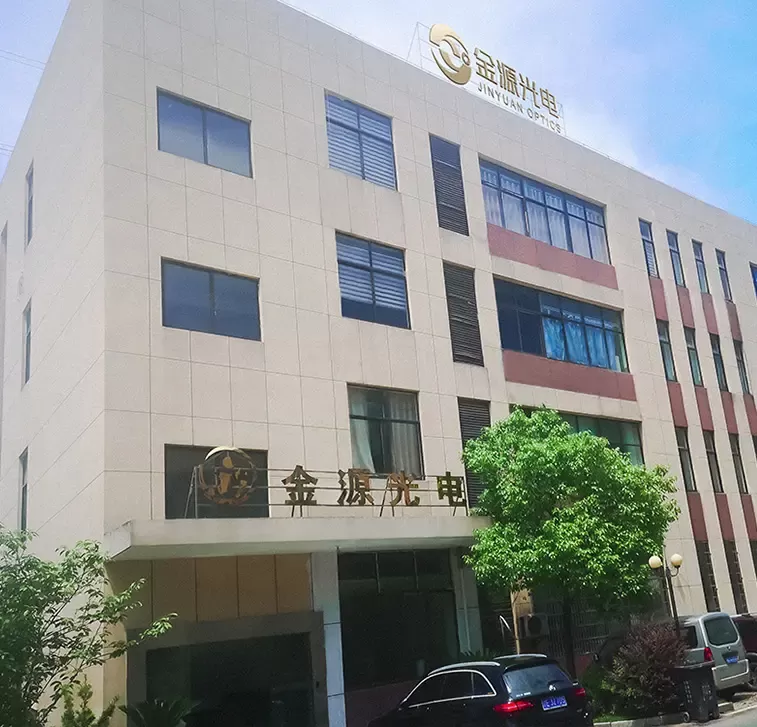

Modern video surveillance no longer relies on standard, catalog-bought optics. High-resolution edge AI, non-standard sensor formats (such as 1/1.8" and 1/1.7"), and harsh operating environments demand application-specific lens assemblies. Selecting the right optical engineering partner defines your camera system's imaging performance.
If your project requires tight optical tolerances, wide-temperature stability, or unique mechanical housing, you need a qualified manufacturing partner. Jinyuan Optics delivers precision-engineered, custom optical solutions directly to system integrators and camera OEMs worldwide. Contact Jinyuan today to review your optical specifications or request custom engineering samples.
Engineering Trends Driving Custom Optics in 2026
Surveillance systems have evolved beyond basic video capture. Network cameras now execute real-time neural network inference, automated license plate recognition (ALPR), and low-light facial tracking. These advanced workloads expose the limitations of off-the-shelf lenses.
Several technical factors make custom design mandatory for modern camera systems:
- Large-Format Sensor Integration: Edge-AI processors require high signal-to-noise ratios, pushing sensor sizes from classic 1/3" formats to 1/2", 1/1.8", and 1/1.7" chips. Standard S-mount optics often vignette on these large image circles without tailored optical configurations.
- True Day/Night Athermalization: Shifting ambient temperatures (-40°C to +85°C) warp mechanical barrels and alter optical glass refractive indices. Uncompensated optics lose focal plane alignment, degrading automated analytics.
- Dual-Band Parfocal Performance: Surveillance systems rely heavily on 850nm and 940nm active infrared illumination. Poor chromatic aberration correction causes substantial focus shift between daytime visible spectra and nighttime IR capture.
Evaluation Criteria: How to Select an Optical Partner
Selecting an optical vendor requires rigorous auditing of their manufacturing and testing processes. Commercial procurement teams and optical systems engineers should evaluate every prospective security application lens manufacturer across four critical criteria:
1. In-House R&D and Optical Simulation
Top-tier manufacturers do not outsource lens design. They run proprietary Zemax or Code V simulations to optimize surface curvatures, reduce lens element count, and maximize relative illumination. A capable vendor validates optical prototypes rapidly using precision diamond-turning or rapid tooling before initiating mass glass molding.
2. Quality Control and Environmental Testing
Manufacturing precision optics requires rigorous production control. Facilities should hold ISO 9001 certification and operate Class 10,000 or Class 1,000 cleanrooms. Look for automated verification testing against the Modulation Transfer Function (MTF) and full compliance with optical drawing standards, such as ISO 10110.
3. Athermal Mechanics and Material Selection
A resilient security lens must combine optical elements with balanced thermal expansion coefficients (CTE). Vendors should offer metal barrels (brass, aluminum) or specialized polycarbonates paired with specific crown and flint glasses to hold back focal length (BFL) across demanding thermal profiles.
4. Customization and OEM Scalability
A reliable supplier must handle both small-batch pilot builds and volume manufacturing. Whether modifying an M12 thread pitch, applying anti-reflective (AR) coatings for targeted wavelengths, or developing an IP67-sealed housing, your manufacturer must adapt to your mechanical envelope.
Top 10 Security Application Lens Manufacturers
The following rankings evaluate production capacity, optical performance, customization capabilities, and technical support across the global imaging industry.
#1 Jinyuan Optics (Best for Custom Optical Solutions & OEM)
Jinyuan Optics leads the industry in providing agile, high-precision custom optical solutions and volume OEM manufacturing. With over a decade of dedicated optical R&D, Jinyuan specializes in high-resolution M12 board mount lenses, C/CS-mount machine vision optics, and specialized surveillance assemblies. Their engineering team delivers custom optical modeling, rapid prototyping, and high-volume production backed by ISO 9001 certified cleanroom assembly.
#2 Computar (CBC Group)
Computar maintains a strong global reputation for industrial automation and commercial surveillance optics. Their catalog includes an extensive range of manual and motorized zoom lenses, along with specialized intelligent traffic system (ITS) lenses designed for high-vibration roadside deployments.
#3 Theia Technologies
Theia specializes in ultra-wide lenses featuring proprietary linear optical technology. Their assemblies correct optical barrel distortion mechanically without requiring digital de-warping software, making them an ideal choice for high-end perimeter protection and critical infrastructure.
#4 Tamron
Tamron brings significant optical manufacturing heritage to security and transport applications. They provide high-performance varifocal lenses, ultra-compact zoom systems, and robust long-range security optics engineered for 24/7 traffic monitoring and commercial surveillance.
#5 Fujifilm (Fujinon)
Fujinon manufactures premier long-range surveillance and broadcast-quality security lenses. Known for advanced Day/Night chromatic correction, their telephoto and large-sensor zoom lenses excel in border patrol, coastal monitoring, and airport security infrastructure.
#6 Kowa
Kowa focuses on high-precision optical systems for machine vision and harsh-environment security. Their optics feature ruggedized mechanical designs with locking screws and hardened glass elements, ensuring consistent performance in high-vibration perimeter security setups.
#7 Ricoh
Ricoh provides rugged, high-resolution lenses engineered to eliminate optical distortion in mission-critical environments. Their compact form factors suit factory security, industrial automation monitoring, and specialized airborne surveillance systems.
#8 Edmund Optics
Edmund Optics serves specialized and scientific security integrations. They offer extensive design-to-order optics, high-damage threshold coatings, and advanced diagnostic testing for research laboratories, defense initiatives, and niche surveillance systems.
#9 Sunny Optical
Sunny Optical is a high-volume manufacturing powerhouse producing micro-optics for mobile, automotive, and consumer smart-home devices. Their strengths lie in large-scale injection-molded plastic optics and high-volume consumer security camera builds.
#10 Evetar
Evetar produces standard board-level optics for cost-sensitive security projects. They maintain an expansive catalog of mass-produced M12 lenses designed for standard IPC modules and consumer-grade surveillance cameras.
Spotlight: Jinyuan Optics Engineering Capabilities
When selecting a security application lens manufacturer, system designers face a recurring tradeoff: established legacy brands often resist custom modifications, while cut-rate commodity suppliers lack optical consistency. Jinyuan bridges this gap by functioning as a dedicated custom engineering extension of your development team.
Key technical capabilities at Jinyuan include:
- Full Custom Optical Engineering: Tailored ray-tracing designs to match unique sensor dimensions, telecentricity demands, or low-light F-numbers (down to F1.0).
- Precision M12 Board Mount Production: Specialized tooling for compact S-mount housings with micron-level thread tolerances and specialized IR cut/pass filter integration.
- Rigorous MTF and Optical Bench Testing: Every custom production run undergoes 100% optical quality inspection, assessing center-to-edge resolution, optical distortion, and stray light suppression per SPIE optical engineering practices.
- Agile Prototyping: Accelerated turnarounds for initial
optical samples, allowing embedded vision engineers to validate camera
prototypes early in the product lifecycle.
Featured Jinyuan Security Lenses for Advanced Systems
To understand Jinyuan's production capabilities, review these five proven optical assemblies deployed across high-performance security, transport, and vision applications:
1. 5MP 25mm IR Correction M12 Fixed Focus Lens
Engineered for narrow-field perimeter surveillance and long-distance inspection, this 25mm fixed-focus optic pairs tight mechanical tolerances with an M12 thread. It incorporates dedicated athermal mechanics, keeping focus stable from sub-zero conditions up to high summer heat. Advanced broadband AR coatings and optical element spacing prevent focal shift between day-lit scenes and 850nm active IR nighttime illumination.
Primary Applications: Long-range perimeter cameras, industrial process tracking, fence-line intrusion monitoring.
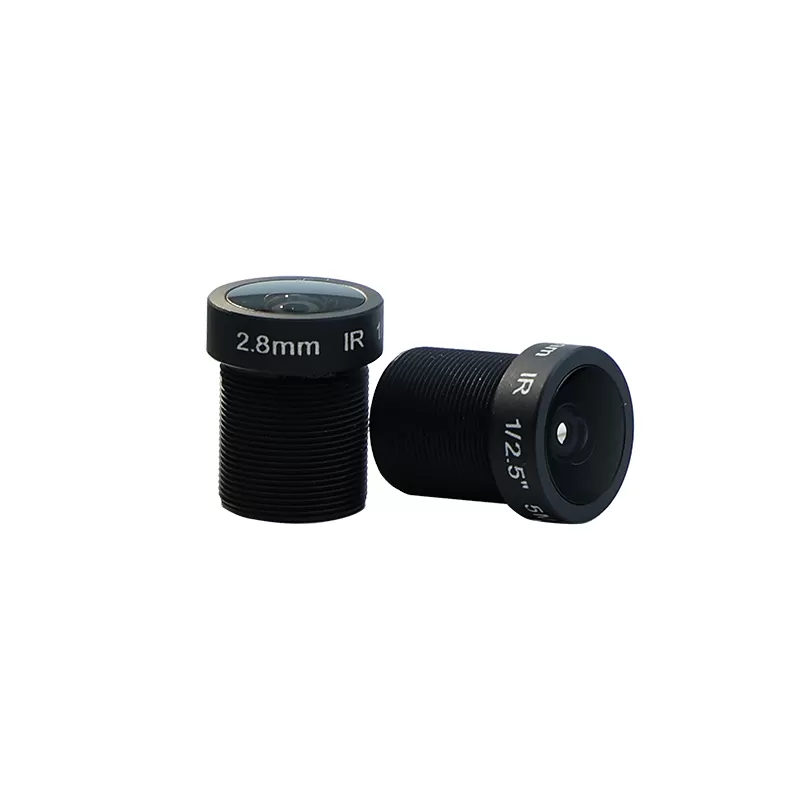
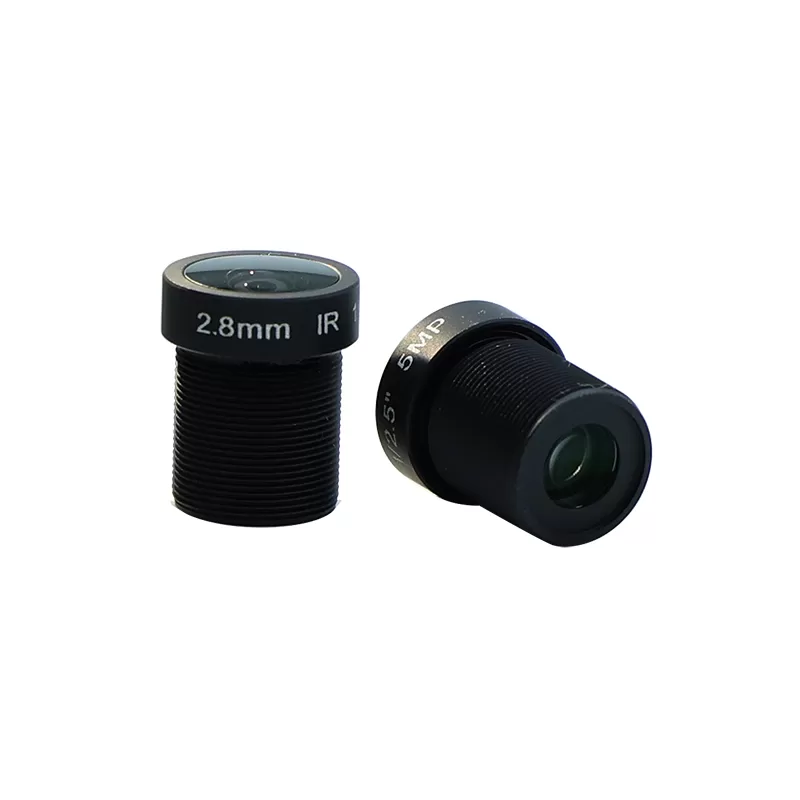
2. 1/2.5" 5MP 2.8mm M12 IR Corrected Lens (JY-125A028FB-5MPIR)
Designed for compact, wide-angle indoor and outdoor network cameras, this 2.8mm assembly pairs cleanly with 1/2.5-inch sensors. It delivers crisp 5-megapixel clarity across the full field of view while controlling edge astigmatism. True Day/Night optical parfocal engineering eliminates the need for software refocusing when switching to night mode.
Primary Applications: Smart city surveillance, commercial building access control, dome network cameras.
3. 1/1.7-inch S Mount 12MP 3.2mm Security Camera Lens
High-resolution AI recognition systems require large-format sensors to gather sufficient light without introducing electronic noise. This 12MP lens covers up to 1/1.7-inch image circles. Despite its wide 3.2mm focal length, it controls barrel distortion and preserves edge-to-edge sharpness for algorithmic processing.
Primary Applications: AI facial recognition terminals, wide-area public square monitoring, UAV search-and-rescue cameras.
4. 1/1.7-inch S Mount 12MP 5mm Security Camera Lens
Balancing wide-area situational awareness with targeted pixel density, this 5mm lens extracts maximum detail from 12MP sensors. The optical design optimizes light transmission, making it ideal for starlight sensor architectures that capture high-speed motion in poor lighting.
Primary Applications: Automatic License Plate Recognition (ALPR/ANPR), traffic flow analysis, border checkpoint inspection.
5. 1/2” High Resolution Low Distortion Board Mount Lens
Standard security lenses frequently exhibit optical barrel distortion between 15% and 30%. This assembly reduces optical distortion to under 1.5% through precision glass element profiling. It bridges the gap between wide-angle security surveillance and industrial machine vision.
Primary Applications: Factory floor security combined with visual inspection, logistics tracking, LiDAR-visual fusion systems.
Technical Guide: How to Specify a Custom Security Lens
When requesting engineering quotations or starting a custom optical design cycle, your hardware team should provide a complete technical specification package.
Sensor Format and Image Circle Matching
Lenses are designed for a maximum image diagonal. Placing a lens built for a 1/3" sensor onto a 1/2" or 1/1.7" sensor causes severe optical vignetting and black borders. Always define your active sensor array dimensions, pixel pitch (e.g., 2.0µm, 1.4µm), and target chief ray angle (CRA) so the optical vendor can match sensor micro-lens acceptance angles.
IR Chromatic Correction (Day/Night Parfocal)
Standard glass exhibits distinct refractive indices for visible light (400-700nm) and near-infrared light (850-940nm). Without specialized low-dispersion crown glass, your system will blur when the mechanical IR-cut filter switches out at night. Specify whether your deployment uses 850nm or 940nm illuminators to ensure the designer controls chromatic aberration across that exact bandwidth.
Thermal Drift and Environmental Sealing
Outdoor surveillance enclosures experience severe thermal shifts. Optical materials expand and contract, causing the focal point to drift away from the sensor surface. Ask your manufacturer for an optical athermalization report, and specify environmental protection levels (such as IP67 front element sealing or anti-fog hydrophobic coatings) up front.
Frequently Asked Questions
Q1: What are the typical lead times and NRE costs for a custom
surveillance lens build?
A1: Non-Recurring Engineering (NRE) costs
vary based on optical complexity, element counts, and barrel tooling
requirements. Prototyping typically takes 4 to 8 weeks, covering optical design,
tooling fabrication, sample polishing, and cleanroom assembly. Production
scaling follows verification testing within 6 to 10 weeks.
Q2: Why does an IR-corrected surveillance lens matter if our cameras
use edge AI autofocus?
A2: Fixed-focus board cameras cannot adjust
focal depth mechanically. If the lens lacks true optical Day/Night parfocal
correction, the focus shifts noticeably under infrared light. This optical blur
degrades AI identification confidence, particularly for license plate capture
and facial recognition.
Q3: How does an M12 (S-mount) lens differ from a C or CS-mount
lens?
A3: M12 (S-mount) lenses use a compact M12x0.5mm thread
directly integrated onto the sensor PCB, offering a small footprint and high
vibration resistance for embedded systems. C and CS-mount lenses use larger
1-inch threaded barrels with specific flange focal distances (17.526mm for
C-mount, 12.526mm for CS-mount), commonly used on larger standalone box
cameras.
Q4: Can Jinyuan Optics manufacture custom lenses in low production
volumes?
A4: Yes. Jinyuan supports rapid engineering verification
through low-volume prototype builds. Once your design passes testing and
integration validation, our ISO-certified facilities scale seamlessly to
high-volume commercial production.
Q5: What metrics quantify optical distortion in security
lenses?
A5: Optical distortion is typically measured as TV
distortion or radial distortion (percentage displacement from the theoretical
point). Standard fisheye or ultra-wide lenses may exhibit -20% or more barrel
distortion, whereas precision low-distortion lenses reduce this below -1.5% to
preserve geometric accuracy for AI recognition models.
Choose Jinyuan Optics as Your Optical Partner
Building next-generation surveillance systems requires more than standard off-the-shelf camera lenses. Whether you are developing an AI-driven traffic checkpoint system, ruggedizing an outdoor PTZ unit, or integrating embedded vision on aerial drones, your optical hardware defines your system's capabilities.
Jinyuan Optics delivers precision-engineered, cost-efficient custom optics tailored to your mechanical envelope, sensor format, and environmental requirements.
Need a tailored optical design for your next security camera project? Send your technical requirements to the Jinyuan engineering team today to request a design consultation, technical drawing review, or customized sample quotation.