
In precision optics, the effective focal length (EFL) directly determines a lens system's field of view, magnification, and working distance. Among the vast range of focal lengths, the Efl 50mm long focal length occupies a distinct position: it bridges conventional imaging and telecentric-like performance for small-format sensors, offering narrow angular coverage and high lateral resolution. For B2B customers — from industrial inspection integrators to biomedical instrument developers — specifying or customizing a 50mm EFL lens involves far more than picking a catalog part. This article dissects the optical engineering, material science, application-driven requirements, and quality protocols behind Efl 50mm long focal length optics, while addressing frequent industry challenges and how Jinyuan delivers tailored solutions for mission-critical systems.
1. Defining the Efl 50mm Long Focal Length in Optical Context
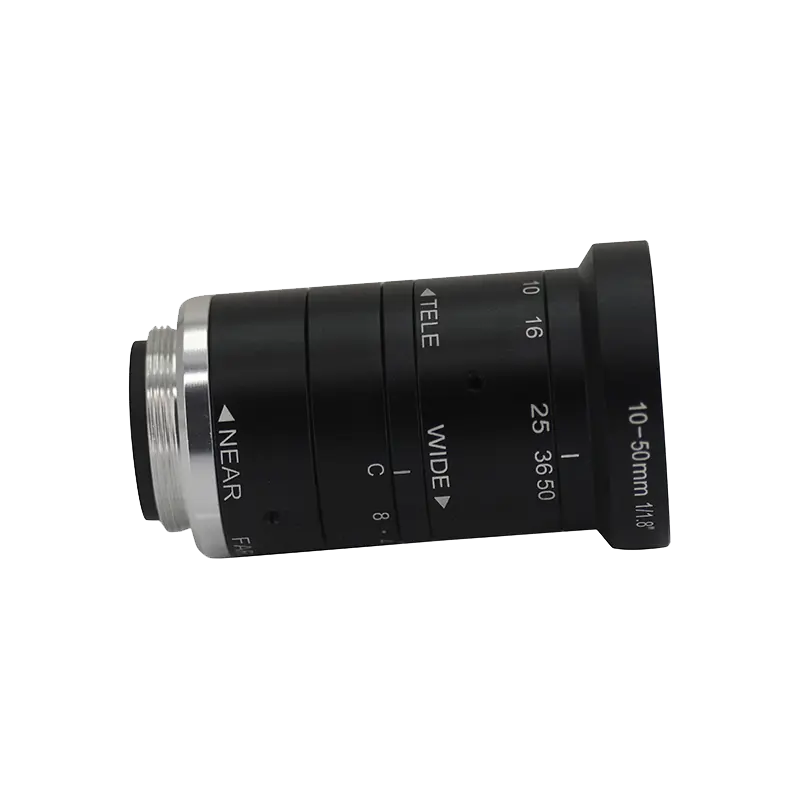
While 50mm is often considered a standard focal length for full-frame photography (43mm diagonal), in machine vision and custom optical assemblies using 1/1.8″ or 2/3″ sensors (diagonals ≈ 8.9mm to 11mm), an Efl 50mm long focal length behaves as a true long-focus lens. The ratio of focal length to sensor diagonal exceeds 4.5, producing a narrow field of view (typically 6°–10°) and high angular resolution. This characteristic is vital for detecting small defects over long distances, reading barcodes in warehouse automation, or focusing on microscopic features in laser scanning systems.
Key parametric implications of a 50mm EFL lens for small-format detectors:
Working distance vs. magnification: A 50mm lens at 0.5x magnification requires about 150mm object distance. At 1x, the object distance approaches 100mm, enabling compact inspection layouts.
Depth of field (DOF): For a given f-number (e.g., f/2.8), DOF shrinks quadratically with longer focal length, demanding precise auto-focus or telecentric stop placement.
Diffraction-limited resolution: The Airy disk diameter at f/4 for 550nm light is approx. 5.4µm, well matching modern 5MP to 12MP sensors with 2.2–3.45µm pixels.
Customization of Efl 50mm long focal length lenses becomes necessary when off-the-shelf products cannot meet exact back focal length constraints, spectral band requirements, or environmental stability. Jinyuan frequently works with clients to redefine the lens prescription around a nominal 50mm EFL while balancing cost, volume, and performance.
2. Optical Design Considerations for 50mm Long Focal Length Systems
Designing a high-performance lens at 50mm EFL involves multiple degrees of freedom. Unlike shorter focal lengths, a 50mm long-focus lens allows relatively moderate ray angles, reducing some aberrations but introducing new constraints such as increased sensitivity to decenter and tilt. Below are four core design aspects:
2.1. Lens Form Selection: Double Gauss vs. Telephoto vs. Modified Triplet
The classical Double Gauss (6 or 7 elements) provides wide aperture (f/1.4 – f/2.8) with good aberration correction. However, for Efl 50mm long focal length industrial lenses requiring compact mechanical length (<45mm), a telephoto-like grouping (positive front group, negative rear) shortens overall length to 0.7–0.8× EFL. For high-uniformity illumination or line-scan applications, a symmetric modified triplet with aspherical surfaces offers nearly distortion-free imaging at lower element count.
2.2. Material Selection and Athermalization
Many precision systems operate across -10°C to 60°C. Standard crown and flint glasses (e.g., N-BK7, F2) shift focus by 20–40µm/°C, unacceptable for high-magnification setups. Custom solutions include:
Using low-thermal-expansion glasses like N-PK51 or N-PK52A.
Integrating passive athermalization via mechanical housing made of aluminum or titanium with matched CTE.
Adopting hybrid designs with one or two diffractive optical elements (DOEs) to compensate thermal defocus.
Jinyuan’s engineering team evaluates material trade-offs (Abbe number, transmission, cost) and provides athermalized Efl 50mm long focal length designs for outdoor surveillance, automotive lensing, and high-power laser focusing.
2.3. Aperture Stop Placement and Telecentricity
For metrology applications where magnification varies with object distance, a telecentric stop at the rear focal plane ensures constant magnification. A 50mm EFL lens with an entrance pupil at infinity (object-side telecentric) demands the aperture stop exactly at the front focal point — challenging with long back focal distance but achievable with retro-focus or reversed telephoto architecture. Partial telecentric behavior can be obtained while maintaining Efl 50mm long focal length by inserting a field lens near the intermediate image plane.
3. Key Application Domains Demanding 50mm Long Focal Length Custom Optics
Across B2B sectors, the need for precisely tailored 50mm EFL lenses spans from sub-micron inspection to long-range optical coherence tomography. The following industries represent the highest demand for custom 50mm long focal length assemblies:
Semiconductor wafer inspection: Detecting sub-0.5µm defects at 50–80mm working distance with high numerical aperture (NA up to 0.3). A 50mm EFL objective with built-in variable aperture and chromatic aberration correction over 400–700nm.
Laser material processing: Focusing 1064nm or 532nm lasers through a 50mm f-theta lens for marking polymers and metals. The long focal length provides a larger scan field while maintaining spot size < 20µm.
Medical endoscopy and surgical guidance: Miniature 50mm long focal length relays for 3D stereo laparoscopes, delivering high resolution at depth without distortion.
Remote sensing and drone payloads: Lightweight (sub-30g) 50mm EFL lenses for multi-spectral vegetation monitoring. Custom AR coatings for 450nm, 550nm, and 850nm bands with anti-reflection below 0.5%.
Biometric identification: Iris recognition modules at 30–40cm distance, where a 50mm EFL lens with fixed focus and large depth of field (f/5.6–f/8) resolves 400 lp/mm center.
Each application imposes unique constraints: spectral transmission, flare suppression, or mechanical shock resistance. Jinyuan’s approach begins with a comprehensive requirement review, then proceeds to optical design, prototyping, and metrology validation for each Efl 50mm long focal length project.
4. Industry Pain Points and Custom Engineering Solutions
Designing a custom 50mm long focal length lens rarely follows a straight path. Below we address three frequent pain points reported by B2B system integrators and the corresponding solutions enabled by advanced manufacturing.
Pain Point 1: Residual Lateral Color (Chromatic Difference of Magnification)
Multi-spectral sensors (RGB or NIR) often show color fringing at the field periphery when using a simple achromat. The root cause: mismatched partial dispersion ratios of glasses. Solution: Employ a three-element apochromatic design using anomalous dispersion glasses such as S-FPL51 or S-FPL53 combined with high-index flints (S-TIH53). This reduces secondary spectrum to less than 3µm across 450–700nm, invisible even on high-resolution sensors. Jinyuan offers custom apochromatic 50mm long focal length lenses for demanding color line-scan cameras.
Pain Point 2: Field Curvature Reducing Edge Sharpness
For flat object planes (e.g., PCB or wafer inspection), field curvature is a known enemy. A 50mm lens with Petzval sum not corrected will have edges focused at a different plane compared to center. Solution: Introduce a meniscus negative element near the aperture or use aspherical surfaces on the last two elements. An aspherical molded glass element can reduce field curvature by 70% while keeping element count low. Jinyuan produces hybrid spherical-aspherical designs for 50mm long focal length assemblies that achieve MTF > 0.4 at 120 lp/mm across a 8mm diagonal.
Pain Point 3: Ghost Reflections and Stray Light in High-Contrast Scenes
Long focal length lenses are prone to internal reflections between lens surfaces when imaging bright sources (e.g., laser diodes or backlit objects). Solution: Multi-layer broadband anti-reflection coatings with residual reflectance < 0.2% over the operational band. Additionally, opto-mechanical baffles and blackening of lens edges significantly reduce veiling glare. Jinyuan supports custom coatings (VIS, NIR, UV) and stray light analysis during the design phase of every Efl 50mm long focal length project.
5. Precision Manufacturing and Quality Assurance for 50mm EFL Lenses
Translating a high-performance design into a reliable optical component requires stringent fabrication tolerances. For 50mm long focal length lenses, the most critical parameters include:
Radius and irregularity: Spherical surfaces within ±0.05% of design radius, irregularity < λ/4 at 632.8nm.
Centering error (decenter & tilt): Edge thickness difference ≤ 5µm, wedge ≤ 1 arcminute. Poor centering directly introduces coma and astigmatism in a 50mm focal length system.
Surface roughness: After polishing, roughness < 0.8nm Ra to minimize scatter at shorter wavelengths.
At Jinyuan, each lens element passes through interferometric testing (Zygo or 4D) and a custom-built MTF measurement station. For complete 50mm long focal length assemblies, we provide a full metrology report including through-focus MTF, distortion grid measurement, and transmission spectrum. This level of quality control aligns with ISO 10110 standards and satisfies rigorous B2B acceptance protocols.
6. Future Trends: Adapting Efl 50mm Long Focal Length Lenses to New Platforms
The evolution of computational imaging, compact hyperspectral sensors, and AI-driven inspection is reshaping requirements for fixed-focal-length optics. The 50mm EFL platform is being optimized for:
Liquid lens integration: Fast autofocus over 200mm to infinity without moving groups.
Freeform surfaces: Ultra-low distortion (<0.1%) across a larger field.
Manufacturing scalability: Precision glass molding for high-volume delivery (10k+ units) with stable quality.
Jinyuan invests in molding technology and metrology equipment to keep pace with these developments, ensuring that custom Efl 50mm long focal length solutions remain cost-effective without performance compromises.
Frequently Asked Questions (FAQ) About Efl 50mm Long Focal Length Custom Optics
Q1: What is the practical difference between a 50mm EFL lens and a
35mm lens for high-resolution industrial imaging?
A1: A 50mm long
focal length provides roughly 30% narrower field of view and 40% higher
magnification compared to a 35mm lens at the same working distance. This makes
the 50mm EFL preferable for detecting small defects (e.g., 10µm particles) on
large objects when the sensor pixel size is fixed. However, it demands more
precise alignment and a stiffer mechanical housing.
Q2: Can Jinyuan produce a 50mm long focal length lens with a
customized back focal length (BFL) to fit a liquid lens or filter
wheel?
A2: Yes. Jinyuan specializes in BFL customization – from
standard 17.5mm to extended 30mm or more. By adjusting the last lens group or
adding a field flattener, we preserve image quality while accommodating
mechanical interfaces. Each design is verified with raytrace simulation before
fabrication.
Q3: What is the typical achievable MTF for a custom Efl 50mm long
focal length lens at f/2.8?
A3: A well-corrected 50mm design (7
elements, with one asphere) can achieve >0.5 MTF at 80 lp/mm on-axis and
>0.4 at 60 lp/mm at the corner of a 2/3″ sensor. For diffraction-limited
applications at smaller apertures (f/4–f/5.6), MTF can exceed 0.6 at 100
lp/mm.
Q4: How does temperature variation affect a 50mm long focal length
lens and how do you compensate?
A4: Without athermalization, a 20°C
temperature change can shift focus by ~50µm, reducing contrast by 30% at high
resolution. Jinyuan offers passive athermalization by pairing a polycarbonate or
aluminum housing with a specific glass combination (low dn/dT). For extreme
ranges (-20°C to 70°C), active focus compensation or a mechanical floating
element is recommended.
Q5: What information should I provide to get a quotation for a custom
50mm EFL lens?
A5: Please share: sensor format (diagonal size),
required working distance range, f-number, spectral band, resolution target
(lp/mm or pixel size), environmental conditions (temperature, humidity,
vibration), and estimated annual volume. Jinyuan then proposes an optical
design, tolerance analysis, and prototype schedule.
Request Your Custom Efl 50mm Long Focal Length Solution
Whether you need a high-resolution 50mm lens for semiconductor inspection, a ruggedized version for outdoor robotics, or a low-distortion assembly for metrology, Jinyuan provides end-to-end engineering and manufacturing. From concept design, prototyping, to volume production, we align with your project milestones.
Contact our optical engineering team today: Share your specification sheet or application notes. We will respond with a technical feasibility study and a structured development plan for your custom Efl 50mm long focal length lenses.
Send your inquiry to Jinyuan now – precision optics tailored for your success.