
Meta description: Explore common industrial lens mounts including C-mount, CS-mount, M12 mount, M14, M16 and F-mount. Learn flange focal distance rules, compatibility, installation tips and how to pick the right machine vision lens mount for inspection, traffic, security and embedded camera projects.
Choosing the correct machine vision lens mount is one of the most important decisions for any industrial vision, ITS traffic, security surveillance or embedded camera project. Many system integrators and OEM engineers run into imaging issues because they assume matching threads guarantee a working lens setup. In reality, flange focal distance (FFD, also known as flange back distance) determines whether your industrial lens can achieve sharp infinity focus. Every lens mount follows its own mechanical specification, and mismatched lens mount compatibility will result in blurry footage, vignetting, poor MTF performance and unstable vision results.
The C-mount lens is the most popular standard machine vision lens mount for FA industrial lenses and ITS traffic lenses. It uses a 1 32 TPI inch thread and a fixed flange focal distance of 17.526 mm. This cross-brand compatible C-mount standard supports sensors ranging from 1/2 inch up to 1.1 inch and larger formats. Common C-mount lens applications include AOI PCB inspection, precision dimension measurement, barcode and QR code reading, high-speed industrial defect detection, highway traffic capture, license plate recognition, and factory robotic vision. A C-mount lens can work with a CS-mount camera only when paired with a precision 5 mm C-to-CS spacer ring. Without this spacer, the C-mount lens cannot reach infinity focus. It is important to note that a CS-mount lens cannot be adapted to a C-mount camera with a simple spacer or adapter ring. An adapter ring only adds distance between lens and sensor, and we cannot reduce the native flange focal distance of a C-mount camera. This lens mount combination will not achieve infinity focus.

A CS-mount lens shares the identical 1 32 TPI thread as a C-mount lens, but its flange focal distance is only 12.526 mm, 5 mm shorter than the C-mount standard. This shorter profile enables compact camera housings, making the CS-mount lens a traditional go-to lens mount for legacy security box cameras and small-format vision cameras. It is designed for small sensors such as 1/4 inch and 1/3 inch. Typical CS-mount lens applications cover indoor analog security cameras, older surveillance box cameras, basic low-speed object detection and entry-level vision teaching kits. When matching a CS-mount lens with a CS camera body, direct installation works as intended. Even though the threads screw together, a CS-mount lens cannot be adapted to a C-mount camera with a simple spacer or adapter ring. An adapter ring only adds distance between the lens and sensor, and we cannot reduce the native flange focal distance of a C-mount camera. This lens mount combination will not achieve infinity focus.
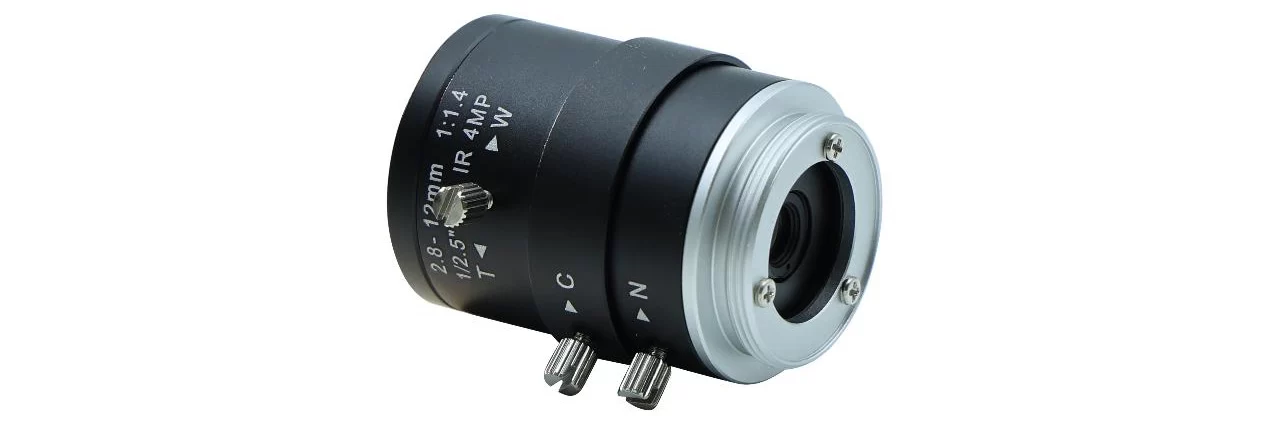
The M12 mount, also called S-mount, uses M12×0.5 metric fine thread. Unlike the standardized C-mount and CS-mount, there is no global unified flange focal distance specification for the M12 lens mount. Each optical manufacturer defines its own mechanical back focal length, which is a major pain point for OEM buyers. An M12 lens from one supplier may thread onto another brand’s M12 camera module, yet remain permanently out of focus. The M12 mount offers compact size and low unit cost, ideal for mass-volume production. Popular M12 lens applications include vehicle ADAS cameras, dashcams, access control facial recognition cameras, USB embedded vision modules, robot obstacle avoidance cameras, smart home IPCs, drone auxiliary cameras and consumer vision hardware. Most M12 board lenses are fixed-focus and fixed-aperture, calibrated for dedicated modules rather than high-precision adjustable industrial inspection.

M14 and M16 mounts are custom threaded lens mount options with less market penetration. M14×0.5 lenses are widely used in aftermarket automotive cameras and compact infrared optical systems. The M16×0.75 lens mount is frequently selected for IR-corrected lenses, medical optics, filter-integrated lens assemblies and miniature thermal auxiliary imaging. Neither M14 nor M16 has a universal flange focal distance standard. To avoid lens mount compatibility failures and IR focus shift, you should pair these lenses with cameras and housings from the same manufacturer. Common M14 and M16 lens applications include portable infrared detectors, biometric capture devices and special miniature industrial monitoring systems.
The F-mount lens uses a bayonet-style connection instead of threads, with a standard flange focal distance of 46.5 mm. This heavy-duty industrial lens mount is built for large-sensor industrial cameras, line scan cameras and scientific imaging equipment. Once your sensor format exceeds 1.1 inch, the inner aperture of a C-mount lens will create obvious vignetting, while an F-mount lens provides a much larger image circle to cover APS-C, full-frame and large line scan sensors. Key F-mount lens applications include web inspection for printing, textile and film production, semiconductor wafer inspection, microscopy auxiliary imaging, high-precision scientific imaging and large-area industrial scanning. Most industrial F-mount lenses feature manual iris without electronic contacts. If you adapt consumer SLR F-mount lenses to industrial vision cameras, you must carefully verify image circle coverage and back focal distance to avoid lens mount related imaging errors.
Other special lens mount options include T-mount and M42 mount. T-mount serves as a universal adapter base for telecentric lenses and astronomical optics. M42 mount appears in custom optical setups and legacy optical systems, with multiple flange variants, so direct cross-brand swapping is not recommended. These mounts are mostly used for custom optical test benches, telecentric measurement stations and amateur astronomical imaging. EF, RF and E-mount are consumer bayonet mounts; they can be used with adapters but are not recommended for long-term machine vision deployment due to calibration drift and stability risks.
Before installing any industrial lens, confirm the native lens mount of your camera first. Always match the lens mount standard with your camera specification. Even if the lens threads in smoothly, double-check the flange focal distance. The lens image circle must fully cover your sensor size, otherwise dark corners and degraded edge MTF will occur. Tighten the machine vision lens with moderate torque and avoid over-twisting. After locking focus and aperture, secure the lock screw properly. For infrared industrial lenses, mechanical back focal length tolerance is extremely tight; tiny deviations on the lens mount will trigger visible IR focus shift. Complete assembly in a dust-controlled environment to prevent CMOS contamination.
FAQ
Q: Can I use a C-mount lens on a CS-mount camera?
A: Yes, but you need a precision 5 mm C-to-CS spacer ring. Without this spacer, the C-mount lens cannot focus at infinity. This spacer must maintain the correct flange focal distance for valid lens mount compatibility. C-mount lenses are the preferred machine vision lens mount for ITS traffic monitoring and high-precision factory inspection.
Q: Can I install a CS-mount lens on a C-mount camera with an adapter ring?
A: No. A standard adapter ring only adds space between the lens and sensor, which increases the flange distance further. The CS-mount lens is designed for a 12.526 mm flange focal distance, while the C-mount camera has a fixed 17.526 mm flange distance. There is no simple spacer or adapter to shorten this distance, so infinity focus cannot be achieved. Some sellers list “CS to C adapters”, but these cannot deliver sharp infinity focus for industrial or surveillance use. CS-mount lenses are mainly designed for legacy small security surveillance cameras.
Q: Are all M12 lenses interchangeable between different camera modules?
A: Usually no. The M12 lens mount has no universal flange focal distance standard. Different manufacturers use different mechanical back focal lengths. For reliable lens mount compatibility, source the M12 lens and camera module from the same optical supplier. M12 lenses dominate mass embedded projects such as dash cams and facial recognition access control.
Q: What is the difference between F-mount and C-mount for industrial cameras?
A: F-mount is a bayonet lens mount with a longer flange distance and larger clear aperture. It supports much bigger sensors for line scan and scientific imaging. C-mount is a threaded, compact machine vision lens mount, the mainstream for mid-size FA and ITS vision applications. F-mount lenses are the top choice for web scanning and semiconductor inspection.
Q: What causes a lens to stay blurry even after I adjust the focus ring?
A: The top causes are mismatched lens mount flange focal distance, incorrect spacer, insufficient image circle, IR focus shift, or a dirty sensor surface. Always check lens mount compatibility first. This blurriness issue is very common when mixing M12 lenses from different OEMs.
Q: Do infrared lenses need stricter lens mount tolerance control?
A: Yes. IR corrected industrial lenses rely on tight mechanical back focal length tolerance. Minor deviation on the lens mount will lead to obvious focus shift between visible light and infrared light. Most infrared industrial lenses adopt M16 or C-mount lens mount standards.
Q: Should I choose C-mount or M12 mount for my embedded vision project?
A: Choose the M12 lens mount if you need ultra-small size, low cost and high volume for simple recognition tasks such as access control and vehicle auxiliary cameras. Choose the C-mount lens mount when you need high resolution, adjustable focus, stable MTF and repeatable optical calibration for inspection, traffic capture and robotic measurement.