
Over the past decade, technological evolution in the security optics industry has solidified a clear functional segmentation between the M12 and D14 mechanical interfaces. The M12 threaded interface—characterized by compact dimensions and cost efficiency—has consistently served the entry-level surveillance segment. In contrast, escalating performance demands in professional security systems—including superior image fidelity, precise electric actuation, and robust all-weather operational reliability—have driven continuous refinement of the D14 straight-through interface. As a result, the D14 has become the prevailing standard for high-end electric security cameras. This hierarchical interface differentiation is now widely recognized across the industry.
Mechanical Compatibility: Purpose-Built for Integrated Electric Drive Architecture
Professional electric security cameras constitute highly integrated opto-electro-mechanical systems.
To support zoom, focus, and aperture control, they must accommodate stepper motors, precision gear trains, axially translating lens groups, and motorized iris mechanisms. The structural distinctions between the D14 and M12 interfaces fundamentally govern the upper limits of mechanical integration density and long-term operational stability.
The internal bore diameter of the M12×0.5 threaded interface measures only 8–9 mm, severely constraining internal layout space. This spatial limitation impedes accommodation of core components required in professional-grade electric lenses—such as dual independent motors, high-ratio gear sets, and axial limit switches. Consequently, most M12-based electric lenses adopt simplified single-motor autofocus architectures, exhibiting narrower zoom ranges, reduced driving torque, suboptimal thermal stability within the −20 °C to +60 °C operating envelope, and elevated long-term failure rates—rendering them suitable primarily for routine indoor or low-stress surveillance applications.
By comparison, the D14 interface—featuring a 14 mm outer diameter and straight-through (non-threaded) axial insertion design—provides substantially greater internal volume. This enables comprehensive mechanical integration, supporting dual stepper motors, high-ratio gear trains, axial limit switches, and high-precision motorized iris actuators. The absence of rotational coupling eliminates torsional interference during actuation; lens groups execute purely linear translation along the optical axis. This design significantly mitigates mechanical hysteresis and jamming risks while enhancing repeatability in positioning accuracy—thereby establishing a more reliable mechanical foundation for sustained, stable operation under demanding conditions. 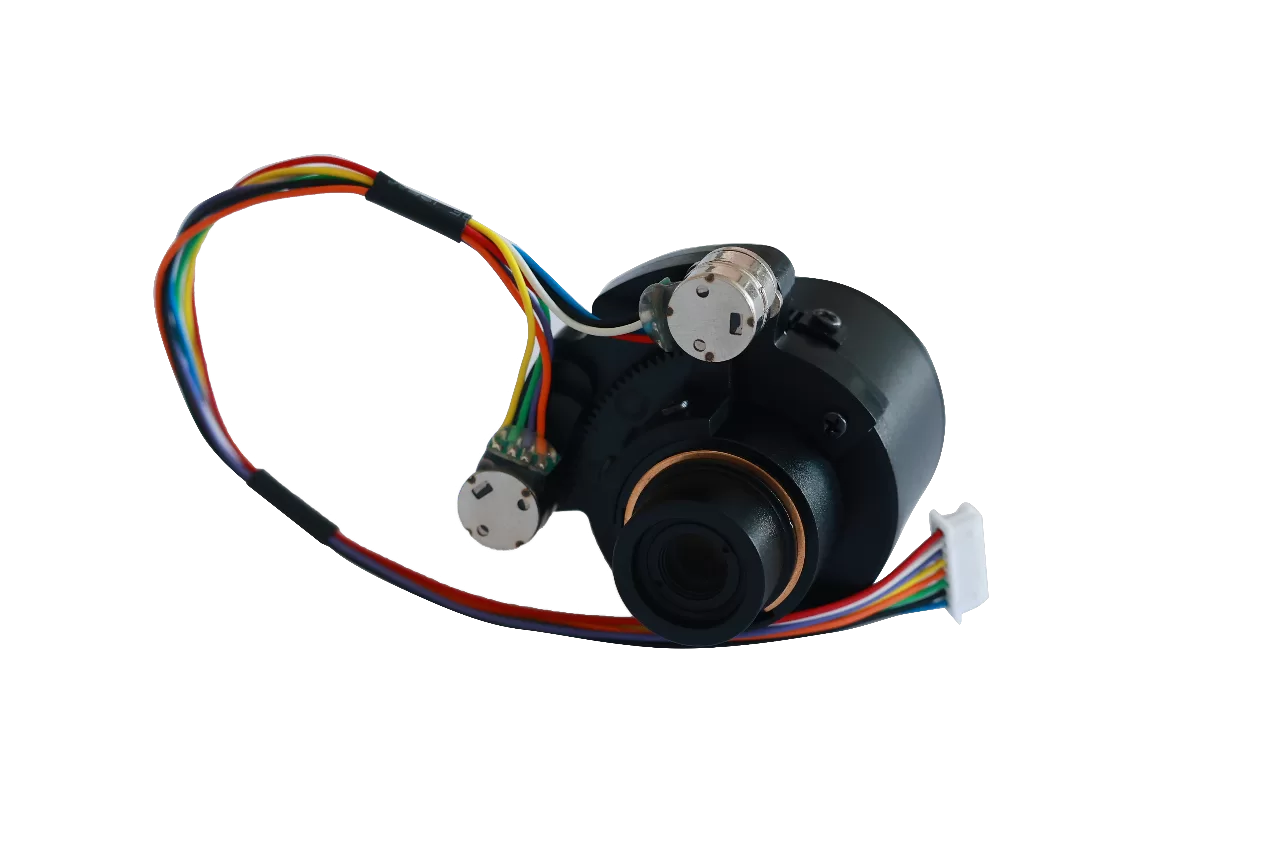
Optical Performance: Distinctive Advantages in Resolution Fidelity and Low-Light Practicality
Real-world surveillance deployments—including urban public safety, traffic monitoring, campus and perimeter protection, and commercial intelligence analytics—operate under complex, often extreme environmental conditions: ultra-low nighttime illumination, strong backlighting, frequent zoom transitions, and continuous 24/7 video capture. These scenarios impose stringent requirements on light throughput, full-field image uniformity, edge-to-edge sharpness across the entire zoom range, and stability during day–night spectral transitions.
Mass-produced M12 electric zoom lenses are typically optimized for sensors ≤ 1/2.7″, with most models offering apertures near F1.6—sufficient for conventional 3–5 MP surveillance applications. However, the M12’s constrained internal volume imposes a hard physical ceiling on rear-group lens size, limiting optical path optimization and preventing significant aperture enlargement. In low-light and high-contrast scenes, M12 lenses exhibit elevated noise, diminished edge resolution at telephoto extremes, focus drift and transient blurring during infrared day–night transitions, and intermittent loss of focus over extended service life. When paired with larger-format sensors (e.g., ≥ 1/1.8″), M12 lenses achieve only pixel-level compatibility—not native full-field resolution utilization.
The D14 interface’s expanded internal architecture affords greater optical design margin, enabling larger entrance pupils and advanced aberration correction. Commercial D14 lenses achieve apertures up to F1.7, with rigorously optimized optical paths that comprehensively suppress spherical and chromatic aberrations, distortion, and field curvature. This yields markedly improved center-to-edge illumination uniformity and consistent edge sharpness across the full field of view. Native compatibility with mainstream 1/2.7″ and 1/1.8″ sensors ensures full-resolution exploitation of 4 MP, 5 MP, and 8 MP imagers. Zoom transitions preserve fine detail more effectively; shared-focus day–night calibration achieves higher precision—minimizing switching blur and focus runout—thus ensuring imaging stability across diverse weather and lighting conditions. This directly enhances AI-driven analytics accuracy and satisfies evidentiary-grade imaging requirements for mission-critical surveillance infrastructure.
Assembly Precision and Structural Reliability: Enabling Industrial-Scale Deployment
A fundamental distinction between the M12 and D14 interfaces lies in their mechanical fixation methodology and resultant long-term optical alignment integrity. The M12 relies on threaded rotation for both mounting and focus adjustment. During focusing, the entire lens barrel rotates synchronously—inducing compressive stress on internal flex cables, encoder assemblies, and lens group mounts. This compromises closed-loop focus repeatability and control stability; prolonged operation inevitably degrades imaging consistency over time.
The D14 interface employs a precision axial sliding assembly coupled with radial locking screws. Zoom and focus motions occur strictly along the optical axis, fully decoupling mechanical fixation from motor-driven actuation. Under thermal cycling and mechanical shock conditions, this architecture maintains tighter tolerance control over back focal length (BFL) variation and delivers superior production-line assembly consistency. It sustains optical alignment integrity across extended operational lifecycles—making it especially suited for harsh outdoor environments typical of dome, PTZ, and long-range bullet cameras. 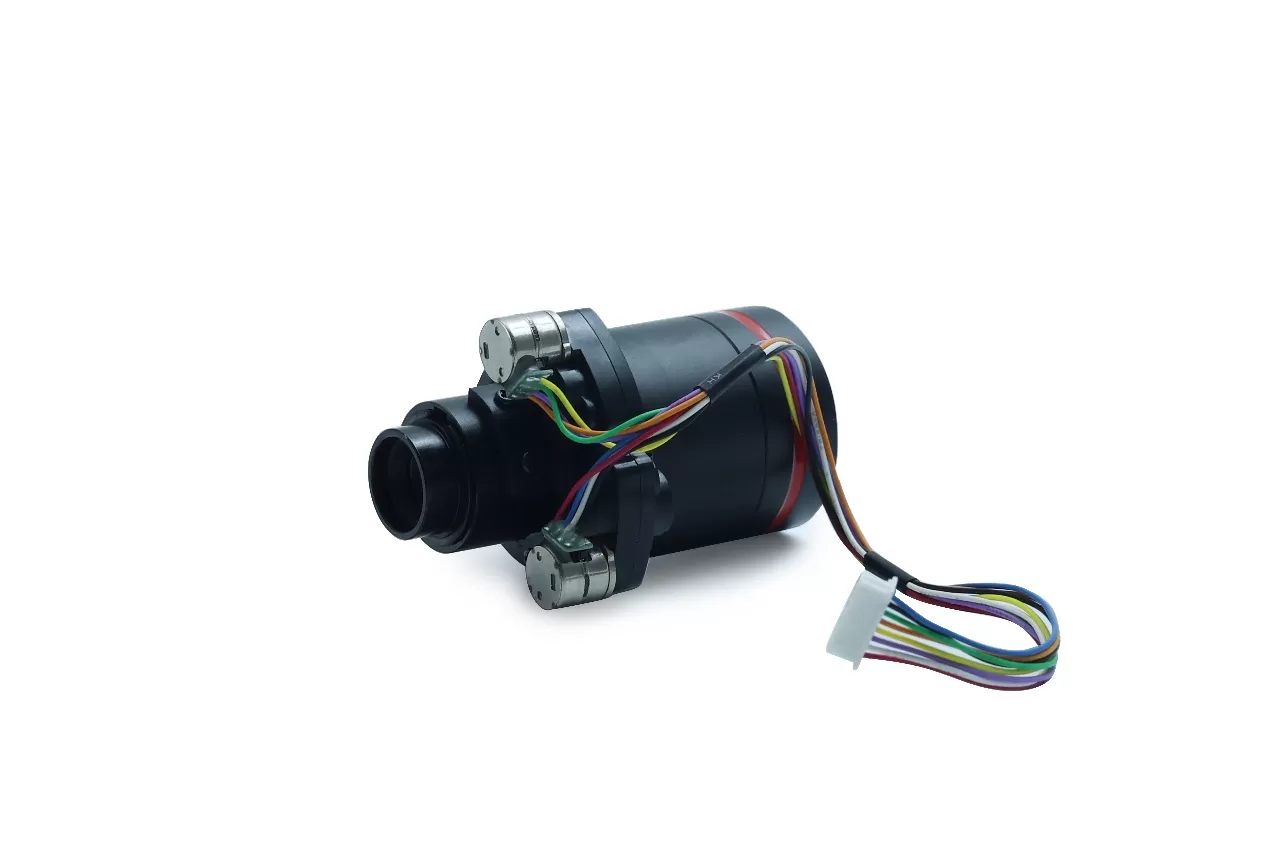
Industry Ecosystem Alignment: Established Application Stratification and Technical Roadmaps
Following over a decade of iterative development, the security optics industry has consolidated a well-defined application hierarchy for M12 and D14 interfaces. The M12 threaded interface serves cost-sensitive, entry-tier use cases—including basic indoor domes, analog HD systems, and budget-oriented OEM modules. Product evolution here emphasizes power efficiency and autofocus speed—yet remains inherently bounded by physical scalability constraints for premium performance attributes.
Conversely, the D14 interface has matured into the dominant, interoperable platform for high-end intelligent optical systems. A robust ecosystem of standardized direct-insert interface specifications now exists industry-wide, ensuring seamless integration with leading image sensors and mainboards. It supports broad compatibility across mid- to high-tier electric zoom lens portfolios and functions as the proven, scalable foundation for mass production of high-performance electric security optics.