
When designing compact camera systems, optical engineers face a balancing act between mechanical constraints and optical performance. The transition from miniature M12 mounts to the D14 board lens represents a direct response to growing sensor dimensions and higher pixel densities. As imaging sensors expand to capture more detail, the physical limitations of smaller lens barrels become apparent. This comprehensive analysis explores the design parameters, application environments, and optical characteristics of the D14 form factor, highlighting how it serves as a bridge between ultra-compact optics and large-format industrial lenses.
For manufacturers and system integrators, selecting the appropriate optical components is highly important for system longevity and image fidelity. Jinyuan assists engineering teams by providing structured optical solutions that address these exact physical and optical demands. Through precise mechanical manufacturing and refined optical layouts, these components help prevent common imaging issues such as corner shading, resolution loss, and thermal focus drift.
The Evolution from M12 to D14 Mounts: Addressing Physical Bottlenecks
The standard M12 lens, often referred to as an S-mount lens, has been the workhorse of small-form-factor cameras for decades. However, as the industry demands higher resolutions, sensor manufacturers have increased the physical size of the silicon active area to maintain acceptable pixel sizes and low-light performance. Common sensor formats have shifted from 1/3-inch and 1/2.7-inch up to 1/2-inch, 1/1.8-inch, and even 2/3-inch sizes.
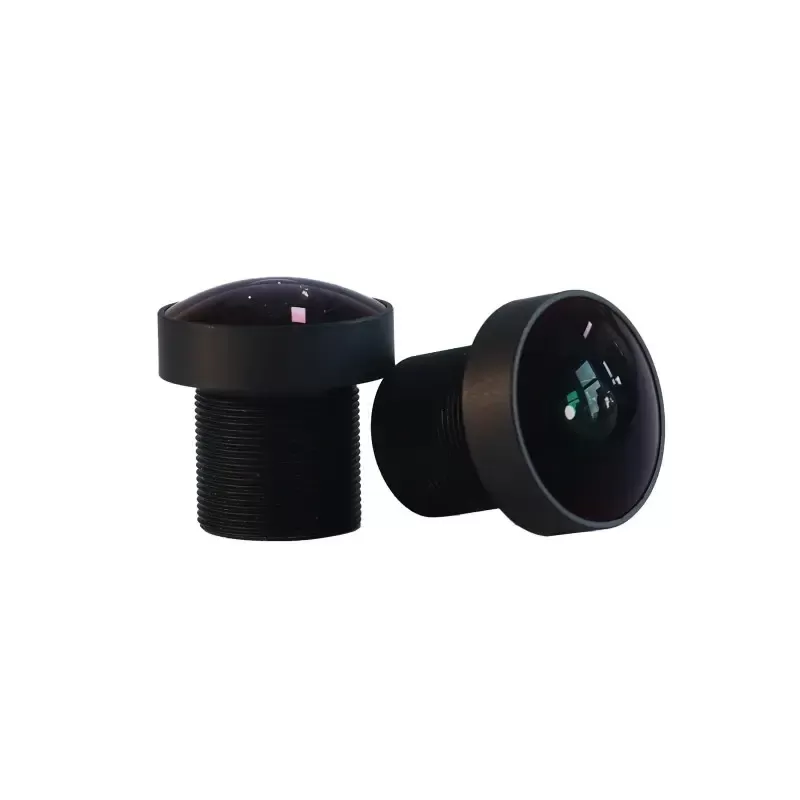
This enlargement of the sensor active area creates a physical bottleneck for M12 barrels, which have a thread diameter of 12mm and a pitch of 0.5mm. The limited internal diameter of an M12 barrel restricts the maximum size of the rear lens element. When a large sensor is paired with a lens that has a small rear element, light rays reaching the corners of the sensor must travel at highly steep angles. This phenomenon, known as a high Chief Ray Angle (CRA), leads to optical issues such as vignetting, severe relative illumination drop-off, and crosstalk between adjacent pixels on the CMOS sensor.
To overcome these mechanical restrictions, the D14 board lens utilizes a 14mm thread diameter, typically with a 0.5mm thread pitch (M14 x 0.5). This additional 2mm of barrel diameter yields a substantial increase in internal cross-sectional area. Optical designers can leverage this extra volume to integrate larger glass elements, particularly at the rear of the optical assembly. By doing so, they can control the light exit angles more effectively, ensuring that the light rays strike the sensor surface as close to perpendicular as possible. The result is a highly uniform distribution of light and color across the entire frame, even when utilizing modern high-resolution, large-format sensors.
Optical Performance Parameters of the D14 Board Lens
Evaluating a D14 board lens requires a deep understanding of several interrelated optical specifications. These parameters define how the lens interacts with the camera sensor and determines the overall quality of the captured image under varying environmental conditions.
Image Circle and Sensor Compatibility
The image circle produced by a lens must completely cover the diagonal of the selected sensor. If the image circle is too small, the corners of the image will appear dark or completely black. A typical D14 board lens is designed to produce an image circle diagonal of 9.0mm to 11.0mm, making it compatible with larger sensors like the 1/1.8-inch and 1/2-inch formats. By matching the image circle to the sensor diagonal, the lens ensures that every pixel, from the center to the extreme corners, receives adequate illumination and resolving power.
Aperture (F-Number) and Light-Gathering Efficiency
The physical size of the 14mm barrel allows for larger entrance and exit pupils compared to standard S-mount options. This enables the design of lenses with wider maximum apertures, such as F1.6, F1.4, or even larger. A wider aperture permits more photons to reach the sensor, which is highly beneficial for low-light applications. In security surveillance and night-time traffic monitoring, a fast aperture reduces the reliance on digital gain, thereby minimizing image noise and preserving fine details without requiring external illumination sources.
Resolution, MTF, and Spatial Frequency
Modern 4K and 8-megapixel sensors feature pixel pitches of 2.0 microns or smaller. Resolving these minute details requires a lens with high spatial frequency performance, measured in line pairs per millimeter (lp/mm). The optical design of a quality D14 board lens incorporates high-index, low-dispersion glass elements to maintain a flat field and minimize chromatic aberration. The Modulation Transfer Function (MTF) charts for these lenses demonstrate high contrast levels even at high spatial frequencies, ensuring that the lens does not become the limiting factor in system resolution.
Key Applications in Professional Vision Systems
Due to its balance of compact size and high optical performance, the D14 board lens is widely deployed across industries where space is limited but image quality cannot be compromised.
Intelligent Transportation Systems (ITS): Traffic monitoring and license plate recognition (LPR) cameras operate under highly demanding conditions. They require high resolution to capture license plate details across multiple lanes of traffic, and fast apertures to operate during twilight and night hours. The mechanical stability of the 14mm mount helps ensure the camera remains in focus despite constant road vibrations.
Industrial Automation and Quality Inspection: Machine vision systems on assembly lines rely on precise geometric measurements. A low-distortion D14 board lens allows inspection cameras to verify dimensions and detect defects with high accuracy, minimizing false rejections caused by optical distortion.
Automotive Vision and Advanced Driver Assistance Systems (ADAS): Vehicles utilize multiple cameras for surround-view monitoring, lane departure warnings, and pedestrian detection. These cameras must withstand extreme temperatures and constant vibration while providing a wide field of view with minimal distortion. The robust mechanical structure of the 14mm housing provides a stable platform for these demanding environments.
Addressing Mechanical and Environmental Integration Challenges
Integrating a D14 board lens into a camera housing involves navigating several engineering challenges, particularly regarding mechanical tolerances and environmental stability.
A common issue in outdoor installations is thermal focus shift. As environmental temperatures fluctuate between daytime highs and nighttime lows, the physical components of the lens and the camera housing expand and contract. If the lens barrel is constructed entirely of plastics with high thermal expansion coefficients, the spacing between the glass elements will change, causing the image to go out of focus. To mitigate this, Jinyuan focuses on optomechanical designs that utilize metal barrels, such as aluminum or brass, combined with carefully calculated element spacings. This passive thermal compensation keeps the focal plane locked onto the sensor surface across a broad operating temperature range.
Another challenge is the precision of the lens mount itself. Standard M14 threads must be machined with extremely tight tolerances. Any tilt or misalignment between the optical axis of the lens and the perpendicular axis of the sensor will result in asymmetrical focus, where one side of the image appears sharp while the opposite side is blurry. High-precision machining of both the lens threads and the camera-side mount is necessary to prevent this issue. Jinyuan employs strict quality control standards during the manufacturing process to ensure concentricity and minimize tilt tolerances, allowing for repeatable, high-yield assembly in OEM production lines.
Selecting and Customizing a D14 Board Lens for OEM Projects
For B2B buyers and system designers, off-the-shelf lenses do not always meet the precise requirements of a specialized project. When specifying a customized D14 board lens, several factors must be carefully defined to ensure the final product performs as expected within the target application.
The customization process begins with defining the core optical requirements:
Focal Length and Field of View (FOV): The required focal length is determined by the sensor size and the target distance of the object being imaged. Whether the system requires a wide-angle view for situational awareness or a narrow field of view for long-distance monitoring, the focal length must be matched to prevent unwanted perspective distortion.
Spectral Transmission and Coatings: Standard lenses are optimized for the visible light spectrum (400nm to 700nm). However, many industrial and surveillance cameras operate in low-light environments using near-infrared (NIR) illumination at 850nm or 940nm. A dual-band or multi-band anti-reflective coating ensures high light transmission in both the visible and NIR spectrums, preventing ghosting and flare while maintaining focus when switching between day and night modes.
Mechanical Envelope and Back Focal Length (BFL): The physical space behind the lens must accommodate optical filters, such as an IR-cut filter switcher, as well as the protective cover glass of the sensor. The mechanical design must specify the exact flange focal distance and back focal length to ensure the lens can be focused properly without striking internal camera components.
By partnering with a manufacturer like Jinyuan, engineering teams gain access to structured design verification processes. This includes optical simulation, prototyping, and rigorous testing using MTF bench tests, environmental chambers, and vibration tables. This collaborative approach ensures that the customized optical assembly matches the mechanical, optical, and environmental requirements of the final product.
Frequently Asked Questions
Q1: What is the main physical difference between a D14 board lens and an M12 lens?
A1: The primary difference lies in the thread diameter of the lens barrel. An M12 lens has a 12mm thread diameter, whereas a D14 lens utilizes a larger 14mm thread diameter. This extra space allows for larger internal optical elements, which improves light gathering, supports larger sensor formats, and reduces corner vignetting.
Q2: Can I mount a D14 board lens directly onto a standard M12 camera mount?
A2: No, you cannot mount it directly because the thread diameters do not match. To use a D14 lens on a camera originally designed for M12, you must either replace the camera's lens holder with an M14-compatible holder or use a mechanical step-up adapter, provided there is enough physical space inside the camera enclosure.
Q3: How does a D14 board lens help reduce corner shading on larger sensors?
A3: Corner shading, or relative illumination drop-off, occurs when the light rays hitting the corners of the sensor are blocked by the lens barrel or arrive at too steep an angle. The larger barrel of the D14 design permits the use of wider rear glass elements, which keeps the light rays more parallel to the optical axis, ensuring uniform brightness across the entire sensor.
Q4: Are D14 board lenses suitable for outdoor applications with extreme temperature variations?
A4: Yes, provided they are designed with appropriate mechanical materials. Lenses built with metal barrels (such as aluminum or brass) and glass optical elements are highly stable. Jinyuan designs these assemblies to minimize thermal expansion, preventing the focus shifts that often occur with plastic components in fluctuating outdoor temperatures.
Q5: What optical coatings are typically applied to these lenses for day/night security cameras?
A5: Day/night cameras typically require multi-layer anti-reflective coatings that are optimized for both visible light and near-infrared (NIR) wavelengths, such as 850nm or 940nm. These specialized coatings prevent focus shift and reduce ghosting when the camera transitions from daytime visible light to nighttime infrared illumination.
Collaborate with Jinyuan for Your Precision Optics Requirements
Selecting the right optical components is a fundamental step in the development of high-performance imaging systems. A minor misalignment or mismatched specification can significantly impact overall image clarity and system reliability. Jinyuan works closely with OEM customers and system integrators to analyze system requirements, refine specifications, and deliver customized optical solutions that meet demanding mechanical and environmental standards.
If you are currently developing a camera system that requires a D14 board lens, or if you need assistance in transitioning from standard M12 mounts to a larger optical format, we invite you to contact our engineering team. Please submit your detailed project specifications, including sensor model, desired field of view, mechanical constraints, and target production volumes, to initiate an engineering evaluation and request a formal quotation.