
Modern banking environments demand higher levels of optical precision. As automated teller machines shift from mechanical cash dispensers to multi-functional financial kiosks, standard off-the-shelf camera lenses no longer deliver adequate performance.
Edge-based artificial intelligence, facial recognition, and strict physical security requirements are reshaping hardware specifications. If you are developing next-generation banking terminals, partner with specialized optical manufacturers like Jinyuan to develop tailored imaging modules. Contact our engineering team today to review your custom lens specifications.
The Evolution of ATM Video Surveillance Equipment in 2026
Automated teller machines once relied on analog pinhole cameras that simply recorded grainy footage to an internal digital video recorder. These passive systems served one function: post-incident forensic review. Today, the role of atm video surveillance equipment has transformed completely.
Modern financial terminals now operate as interactive, real-time security hubs. These units must authenticate users through biometric facial scanning, detect skimming attachments instantly, and monitor surrounding physical spaces for suspicious behavior.
Standard Commercial Off-The-Shelf (COTS) lenses fail to meet these complex operational requirements. Off-the-shelf optics present several design compromises:
- Fixed dimensions that do not fit into slim, modular ATM chassis.
- Generic coatings that cause intense internal flare from nearby touchscreens.
- High optical distortion that confuses modern AI facial recognition algorithms.
- Rapid focus drift across extreme outdoor temperature shifts.
Custom optical components bridge this gap. By tailoring the optical stack to the exact sensor, chassis depth, and environmental profile of the terminal, hardware designers achieve the reliability required for modern banking compliance.
Why Custom Optics Matter for Modern ATM Video Surveillance Equipment
ATM terminals operate in some of the most challenging physical and visual environments in the embedded vision sector. Off-the-shelf cameras inevitably degrade image quality under these real-world constraints.
Extreme Physical Space Constraints
Modern ATMs feature ultra-thin profiles. Internal space must accommodate cash cassettes, deposit modules, card readers, receipt printers, and complex computing hardware.
Camera integration cannot consume excessive depth. Standard security lenses typically require bulky mounts and long barrel designs that clash with interior components.
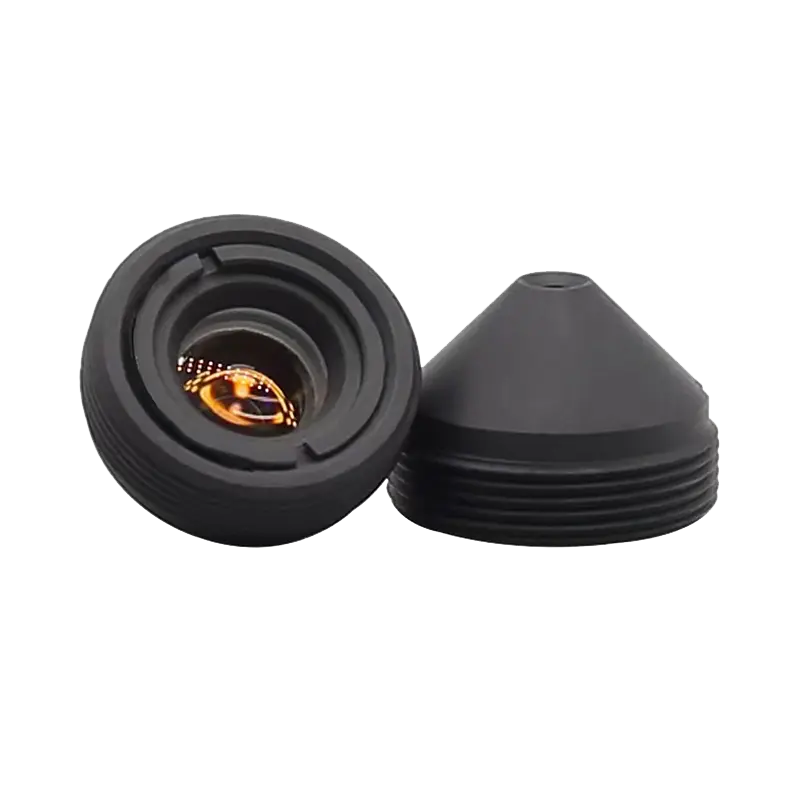
Custom pinhole optics solve this packaging challenge. An optical design tailored to your mechanical envelope places the entrance pupil right at the terminal front plate. This approach reduces overall camera depth without sacrificing sensor illumination or field coverage.
Complex and Hostile Lighting Conditions
An ATM may sit in an open-air drive-through exposed to direct morning sunlight, or inside a dimly lit convenience store under flickering fluorescent tubes. Furthermore, modern ATM fascia incorporate ultra-bright LCD touchscreens, LED indicator strips, and anti-glare privacy filters directly adjacent to the camera aperture.
These intense, localized light sources create major issues for standard lenses:
- Severe veiling glare that blinds the image sensor.
- Ghost artifacts reflecting from internal LED task lights.
- Blown-out highlights when a user stands between direct sunlight and a shadowed kiosk.
Developing a custom optical assembly allows optical designers to apply specialized multi-layer broadband anti-reflective (AR) coatings. These coatings suppress stray internal reflections. When matched with an optical Wide Dynamic Range (WDR) layout, the camera maintains contrast across both facial shadows and sunlit backgrounds.
Physical Protection and Anti-Vandalism Standards
Physical security remains paramount. Cash machines are frequent targets of physical attacks, vandalism, and tampering. Optical elements mounted on the exterior faceplate must withstand blunt impacts equivalent to IK10 standards.
Standard glass easily cracks, while generic plastic windows scratch under aggressive cleaning solvents. Custom solutions incorporate chemically strengthened front elements, such as sapphire glass or gorilla-grade cover plates. Designers also incorporate hidden pinhole apertures that prevent attackers from probing, spraying, or blocking the lens assembly.
5 Critical Optical Parameters to Consider in 2026
When specifying custom optical components for atm video surveillance equipment, engineering teams must evaluate five essential technical dimensions.
1. Field of View (FOV) and Geometric Distortion Control
Traditional ATM security relied on a single wide-angle lens to capture the user and the surrounding environment simultaneously. This compromise caused severe barrel distortion, stretching the user's face at the image perimeter and degrading biometric algorithms.
Leading 2026 kiosk designs deploy dual-optical systems:
- Port 1 (Biometric Face Camera): A narrow field of view (55° to 70° horizontal FOV) lens engineered for zero optical distortion (< 1%). This port captures razor-sharp, photometrically accurate facial features for 1:1 matching.
- Port 2 (Contextual Environmental Camera): An ultra-wide or fisheye lens (110° to 160° horizontal FOV) that monitors hands near the cash dispenser and tracks individuals lingering behind the customer.
Custom optical engineering ensures both lens profiles fit alongside the same processing board while serving their distinct operational tasks.
2. High-Resolution Sensor Matching and MTF Performance
Modern banking cameras utilize high-resolution sensors ranging from 4K (8 Megapixel) to 12 Megapixel formats with micro-sized pixels (often 1.4µm to 2.0µm). A generic lens will blur across small pixels because its optical resolving power fails to match the Nyquist frequency of the sensor.
When selecting custom optics, evaluate the Modulation Transfer Function (MTF) curve across all spatial frequencies. Ensure the lens maintains high contrast resolution not just at the center of the frame, but also out to the extreme corners (0.8 to 1.0 image field). Custom assemblies carefully match the lens Chief Ray Angle (CRA) to the sensor CRA, preventing edge shading and color crosstalk.
3. Aperture Selection and Low-Light Color Sensitivity
Outdoor walk-up ATMs must capture clean, evidentiary-grade video in the middle of the night without blinding the user with intense visible spotlights. Relying on slow f-number lenses (such as F2.4 or F2.8) forces the image sensor to crank up electronic gain, resulting in muddy, noisy footage that defeats video analytics.
Specifying a custom large-aperture lens (F1.2 to F1.6) provides substantial benefits:
- Maximizes light collection during nighttime operation.
- Maintains fast shutter speeds to eliminate motion blur from moving hands.
- Allows the camera module to capture full-color footage under weak streetlights.
4. Infrared (IR) Correction and Multi-Band Performance
Most covert ATM surveillance systems utilize invisible infrared illumination (typically 850nm or 940nm) to avoid attracting unnecessary attention at night. However, glass disperses different wavelengths of light at different angles. A standard visible-light lens shifts focus dramatically when switched to infrared mode, producing soft, out-of-focus nighttime images.
Custom Day/Night lenses solve this problem through true apochromatic design. By incorporating Extra-low Dispersion (ED) glass elements, the optical group brings visible light (400nm–700nm) and near-infrared light (850nm/940nm) to the exact same focal plane. The terminal maintains razor-sharp focus 24 hours a day without mechanical refocusing motors.
5. Biometrics, Depth Sensing, and Anti-Spoofing Integration
Financial fraud methods have advanced rapidly. Criminals now attempt to fool banking terminals with high-resolution silicone masks, printed photos, and deepfake digital screens. As a result, 2026 ATM security mandates liveness detection.
Modern optical modules must support multi-modal biometric capture:
- Near-Infrared (NIR) Bandpass Optics: Blocks ambient ambient visible light while passing 850nm or 940nm light to capture subsurface vascular patterns in skin.
- Structured Light & Time-of-Flight (ToF) Lenses: Custom receiver lenses calibrated for specific laser wavelengths calculate sub-millimeter 3D facial topology.
Engineering these elements as a single integrated custom sub-assembly guarantees optical alignment between RGB, NIR, and depth channels.
2026 Forward-Looking Trends: Empowering AI-Driven ATMs
Smart banking infrastructure relies heavily on automated edge processing. Forward-thinking manufacturers are tailoring their optical architectures to directly complement artificial intelligence models.
Machine-Vision-Specific Optical Optimization
Human security guards view images differently than neural networks. Human eyes prioritize pleasing color saturation and balanced contrast. Neural networks require edge sharpness, consistent gradient changes, and minimal chromatic aberration across high-contrast transitions.
Optical manufacturers like Jinyuan now design custom lenses specifically optimized for machine vision backbones. By fine-tuning lens parameters for neural-network-based object detection, cameras detect card skimming bezels, covert pinhole mirrors, and card-trapping devices with higher accuracy and fewer false alarms.
Athermalization for Severe Thermal Fluctuations
Standalone outdoor ATMs face blistering summer heat and freezing winter conditions. Typical operating ranges span from -40°C to +85°C. In conventional lenses, optical barrels expand or contract at different rates than the glass elements, throwing the system out of focus.
Custom athermal optical designs solve this issue. By blending specific optical plastics, specialized glasses, and compensating metal alloys inside the barrel housing, the system mechanically self-corrects for thermal expansion. The focal point remains stable throughout severe seasonal temperature shifts.
Vendor Selection Checklist for ATM Optics
Selecting the right custom optical manufacturing partner is just as critical as finalizing your optical design parameters. Use this checklist during your vendor evaluation process:
- Optical Simulation and Prototyping Speed: Can the vendor run comprehensive optical simulations (using software such as Zemax or Code V) and provide rapid prototypes within 4 to 6 weeks?
- Quality and Process Certifications: Does the supplier operate cleanrooms certified to ISO 9001 and automotive/industrial-grade standards like IATF 16949? High reliability is non-negotiable for critical banking infrastructure.
- Lens Barrel Environmental Testing: Can the manufacturer verify shock, vibration, moisture ingress (IP66/IP67), and thermal shock performance in-house?
- Supply Chain Longevity: Financial equipment architectures typically run on 5 to 10-year production cycles. Ensure your optical partner commits to long-term component availability without unexpected end-of-life notices.
Frequently Asked Questions
Q1: Why are pinhole lenses widely preferred in ATM video surveillance equipment?
A1: Pinhole lenses feature extremely small entrance pupils (often under 1.5mm to 2mm in diameter). This tiny aperture allows the camera to hide discreetly behind the ATM faceplate or bezel. It protects the camera from direct vandalism, conceals the camera from tampering, and keeps the overall aesthetic of the machine clean.
Q2: What is the primary difference between a standard security lens and a custom ATM lens?
A2: Standard security lenses are built for general-purpose surveillance. They feature bulky housings, generic anti-reflective coatings, and standard focus ranges. Custom ATM lenses feature compact barrels to fit thin kiosk spaces, specialized anti-flare coatings to handle bright ATM touchscreens, precise IR-correction, and zero-distortion profiles optimized for facial recognition.
Q3: How does optical distortion affect modern ATM biometric authentication?
A3: High geometric distortion (such as fisheye or barrel distortion) warps facial landmarks like the distance between the eyes, nose, and mouth. While humans can still recognize the face, computer vision algorithms experience reduced matching accuracy. Custom lenses with less than 1% geometric distortion ensure consistent, accurate biometric verification.
Q4: Why is an athermalized lens necessary for outdoor ATM deployments?
A4: Outdoor ATMs experience temperatures ranging from sub-zero winters to scorching summers. Uncompensated lenses suffer from optical defocus because the lens barrel and glass elements expand and contract at different rates. An athermalized design uses balanced materials to keep the lens sharp across the entire operating temperature range without motorized adjustments.
Q5: Can custom optics improve the lifespan of ATM video surveillance equipment?
A5: Yes. Custom optics built with industrial-grade glass, metal barrels, and chemically strengthened cover windows resist yellowing, delamination, scratches, and vibration damage. This rugged construction prevents premature camera failure and reduces expensive on-site maintenance visits over the terminal's 7 to 10-year service life.
Deploying generic optical hardware in modern banking terminals compromises security, degrades image processing, and increases field failure rates. Custom optical components provide the precise form factors, light transmission, zero-distortion profiles, and thermal stability required for intelligent atm video surveillance equipment.
Investing in custom optical engineering ensures your equipment satisfies the rigorous demands of next-generation financial networks. Jinyuan works alongside leading terminal manufacturers to build rugged, high-resolution optical assemblies tailored to exacting security standards.
Contact our engineering team today to review your mechanical drawings, request Zemax optical simulations, or order custom lens prototypes for your ATM camera platforms.