
Industrial imaging demands consistency, durability, and precise optical performance. In automated inspection, intelligent traffic monitoring, and factory automation, selecting the correct lens mount and focal configuration directly influences the accuracy of data collection. Among the various standards available in the market, the monofocal lens CS mount remains a reliable choice for system integrators who require a compact footprint, robust mechanical stability, and cost-effective deployment.
This design utilizes a specific standard established for smaller sensor formats, providing a shorter flange focal distance compared to its C-mount predecessor. By combining this physical mount standard with a fixed focal length design, manufacturers can produce highly stable optical systems that resist the vibrational and thermal challenges common in industrial environments. Jinyuan manufactures high-performance optical assemblies designed to meet these exact requirements, ensuring that industrial vision systems operate with minimal downtime.
The Mechanical and Optical Standards of the CS-Mount Interface
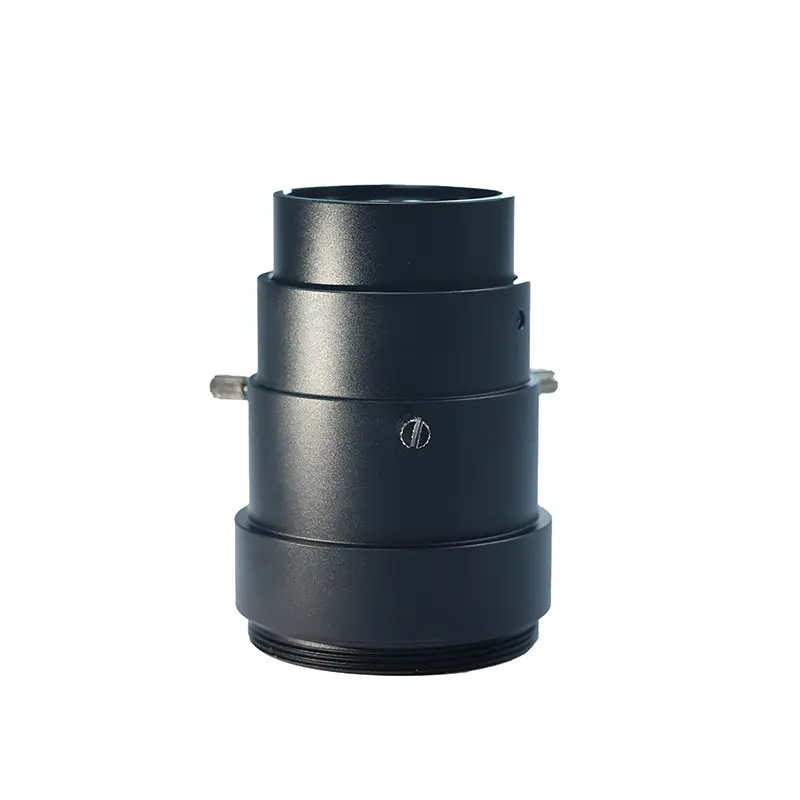
To understand the utility of the monofocal lens CS mount, it is necessary to examine the mechanical dimensions that define the standard. The CS-mount interface features a thread diameter of 1 inch (25.4 mm) with a thread pitch of 32 threads per inch (1-32 UN 2A). The defining characteristic of this standard is its flange focal distance, which is precisely 12.526 mm. This distance represents the physical span from the lens mounting flange to the surface of the image sensor.
In contrast, the older C-mount standard utilizes a flange focal distance of 17.526 mm. The 5 mm difference allows CS-mount cameras to be manufactured with a shallower internal profile, reducing the overall physical depth of the camera housing. While a C-mount lens can be mounted onto a CS-mount camera by utilizing a 5 mm spacer ring, a CS-mount lens cannot be adapted for use on a C-mount camera body, as the lens cannot be positioned close enough to the sensor plane to achieve focus.
Integrating a fixed focal length, or monofocal, design into this mechanical mount standard yields several optical benefits. Because a monofocal lens has no moving zoom groups, the internal barrel construction is remarkably simple. This simplicity reduces the number of glass-to-air interfaces, which in turn minimizes internal light scattering, reflections, and ghosting. The fixed optical path ensures that light transmission remains high, allowing for wider maximum apertures and better performance in low-light environments.
Addressing Industrial Inspection and Deployment Pain Points
System designers face recurring challenges when deploying optical hardware in manufacturing and outdoor monitoring applications. Understanding these pain points reveals why a fixed-focus, short-flange lens system is often the preferred choice for long-term installations.
Vibrational Defocusing in Automation Lines
In robotic assembly lines and high-speed packaging facilities, cameras are subjected to constant mechanical vibrations. Lenses with adjustable zoom mechanisms rely on sliding internal barrels held in place by friction screws or small locking pins. Over time, continuous harmonic vibrations cause these components to slip, leading to subtle defocusing that can ruin automated inspection algorithms. The simplified physical architecture of a monofocal lens CS mount minimizes internal moving parts. The focus mechanism can be securely locked with robust set screws, ensuring that the focal plane remains locked even during intense mechanical stress.
Thermal Drift in Outdoor Monitoring
Intelligent transportation systems and perimeter surveillance setups must operate reliably in environments with extreme diurnal temperature fluctuations. Thermal expansion and contraction affect the refractive index of glass and the physical length of the lens barrel. Multi-element zoom lenses suffer from complex thermal drift, where focus shifts unpredictably across different temperatures. A fixed-focal-length lens exhibits a predictable thermal profile. Jinyuan utilizes temperature-stable optical glass and rugged aluminum or brass housings to construct lenses that maintain their focus from sub-zero winter temperatures to high-temperature summer environments.
Optical Distortion in High-Precision Metrology
Geometric distortion, such as barrel or pincushion distortion, introduces measurement errors in dimensional metrology applications. Zoom lenses are designed to compromise optical performance across a range of focal lengths, often resulting in significant distortion at the wider and narrower limits. A monofocal lens CS mount is engineered and corrected for a single, specific focal length. This singular focus allows optical designers to minimize distortion to sub-pixel levels, enabling accurate spatial measurements without the need for intensive software-based correction algorithms.
Key Industrial Application Scenarios
The structural simplicity and optical performance of fixed-focal CS-mount lenses make them highly suitable for various demanding sectors. Their deployment spans across automation, public safety, and biological scanning.
Machine Vision and Automated Sorting: In conveyor-based sorting systems, cameras must capture sharp images of fast-moving products. The wide maximum apertures typical of monofocal lenses allow for short exposure times, reducing motion blur without requiring excessively bright, expensive illumination systems.
Intelligent Traffic Systems (ITS): License plate recognition cameras mounted on overhead gantries require high-contrast images under variable lighting. A fixed-focus lens set to infinite focus ensures that vehicles traveling at high speeds are captured with maximum edge contrast.
Automated Logistics and Barcode Reading: Distribution centers utilize stationary camera arrays to scan tracking codes on packages of varying heights. The deep depth of field provided by short-focal-length CS-mount optics allows packages within a wide height range to remain in sharp focus.
Medical and Lab Diagnostics: Low-power digital microscopy and slide scanning systems benefit from the flat field performance of fixed focal length lenses, ensuring uniform focus from the center to the very corners of the image sensor.
Procurement Selection Parameters
When selecting a monofocal lens CS mount for a specific integration project, several mechanical and optical specifications must be evaluated to ensure system compatibility.
Sensor Format Compatibility
The image circle projected by the lens must be equal to or larger than the diagonal dimension of the camera's image sensor. Common sensor formats in CS-mount cameras include 1/3-inch, 1/2.7-inch, and 1/2-inch. If a lens designed for a 1/3-inch sensor is paired with a 1/2-inch sensor, severe vignetting and corner shading will occur, rendering the outer edges of the image unusable.
Focal Length and Field of View (FOV)
Because the focal length is fixed, the field of view must be calculated based on the working distance (the distance from the lens front to the object) and the sensor dimensions. A shorter focal length (e.g., 4 mm or 6 mm) provides a wider field of view, suitable for close-up monitoring, whereas a longer focal length (e.g., 12 mm or 16 mm) offers narrower angles of view, ideal for capturing details from a distance.
Aperture Control and Lighting Conditions
Lenses are available with manual, DC-auto, or P-iris aperture controls. For indoor environments with constant artificial illumination, a manual iris lens is ideal, as the aperture can be fixed during installation to maintain a consistent depth of field. For outdoor applications with changing sunlight, a DC-auto or P-iris system is recommended to dynamically manage light intake and prevent sensor saturation.
Jinyuan Customization and Manufacturing Capabilities
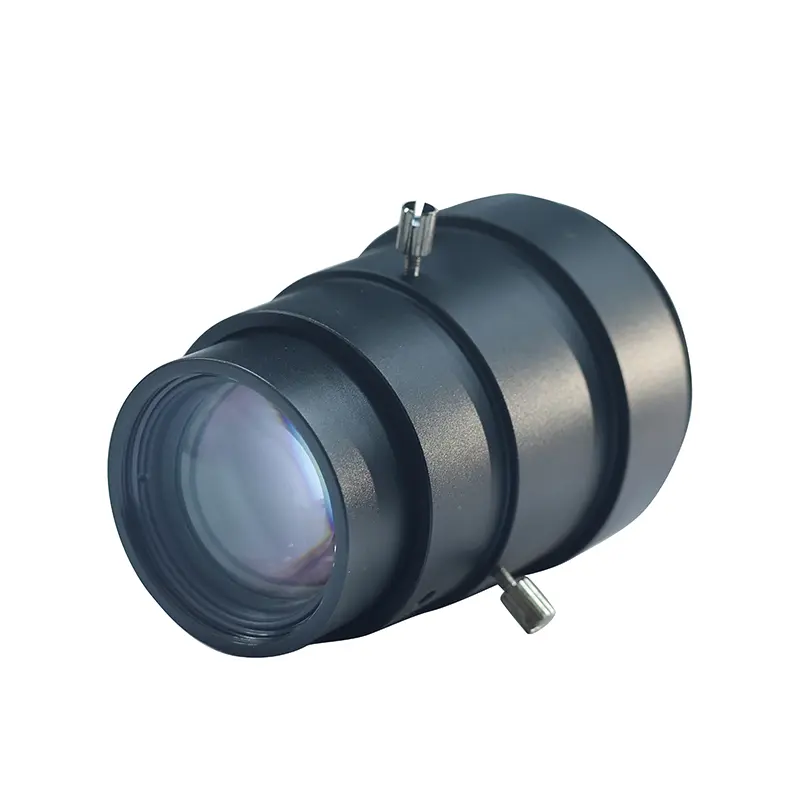
Standard off-the-shelf optical components do not always meet the strict space constraints or harsh environment requirements of specialized industrial systems. Jinyuan provides comprehensive engineering support, from raw optical glass selection to final mechanical housing assembly. The engineering team can customize the lens barrels, modify focus lock designs, and apply specialized anti-reflective coatings to match specific wavelength requirements, such as near-infrared (NIR) spectrum imaging.
By controlling the manufacturing process from design to assembly, Jinyuan ensures that every monofocal lens CS mount meets strict quality control metrics, including Modulation Transfer Function (MTF) testing and environmental stress screening. This level of quality control reduces integration errors and guarantees long-term operational stability in the field.
Frequently Asked Questions
Q1: Can a monofocal lens CS mount be converted for use on a C-mount camera?
A1: No, a physical conversion is not possible without losing the ability to focus at infinity. The flange focal distance of a CS-mount lens is 12.526 mm, which is shorter than the 17.526 mm required by a C-mount camera. Placing a CS-mount lens on a C-mount camera positions the optical elements too far from the sensor plane, making focus impossible unless specialized optical correction lenses are introduced, which degrade image quality.
Q2: What is the primary difference between a C-mount and a CS-mount lens?
A2: The primary difference is the flange focal distance. The CS-mount has a flange focal distance of 12.526 mm, whereas the C-mount has a flange focal distance of 17.526 mm. Both share the same thread specifications (1-inch diameter, 32 TPI), meaning they are physically compatible in terms of threading, but require correct spacing to achieve proper focus.
Q3: Why are monofocal lenses preferred over zoom lenses in automated measurement systems?
A3: Monofocal lenses are preferred because they have a fixed optical path and fewer moving elements. This eliminates the mechanical tolerances and physical shifting associated with zoom lenses, resulting in lower geometric distortion, more stable calibration, and superior repeatability in precise measurement applications.
Q4: How does sensor size compatibility affect the performance of a CS-mount lens?
A4: The lens must project an image circle that completely covers the active area of the sensor. If the sensor is larger than the lens's rated image circle, the corners of the image will appear dark (vignetting) and show increased optical aberrations. Using a larger lens on a smaller sensor is acceptable, but it results in a narrower field of view than the lens's nominal specification.
Q5: Can Jinyuan provide customized anti-reflective coatings for near-infrared applications?
A5: Yes, Jinyuan offers custom thin-film optical coatings tailored for specific spectral bands. For applications utilizing active infrared illumination, such as night surveillance or multispectral analysis, the lens elements can be coated to maximize light transmission in the 850 nm or 940 nm ranges, reducing reflections and maximizing contrast.
Inquiry and Custom Optical Consulting
Selecting the correct optical configuration is a detailed process that depends on your specific camera hardware, workspace constraints, and lighting conditions. Jinyuan works closely with system integrators, OEM partners, and procurement officers to deliver optical solutions tailored to demanding industrial standards.
If you are looking for reliable, high-resolution monofocal lens CS mount solutions, or if you need to discuss custom optical coatings and housing modifications for your project, please contact our engineering sales office. Our team will provide detailed optical datasheets, step-file models, and pricing quotations to support your development timeline.