
Modern visual monitoring systems demand wide spatial coverage without compromising detail retention across the periphery. Achieving a broad field of view requires precise balancing of refractive indexes, mechanical tolerances, and sensor interactions. Integrating a wide angle surveillance camera lens into commercial and industrial vision setups presents specific optical challenges, including field curvature, chromatic aberration, and perspective distortion. Engineering teams must evaluate optical assemblies beyond nominal focal length figures to ensure baseline performance under varying ambient lighting and thermal conditions.
The transition toward higher-resolution image sensors, such as 4K and 12-megapixel formats, shifts focus toward spatial frequency performance across the entire image plane. Standard optics often suffer from severe resolution fall-off near the image corners. Mitigating this limitation requires a deep examination of lens element geometry, glass substrate selection, and multi-layer coating formulations designed to keep light rays properly aligned with modern CMOS pixel structures.
Optical Distortion Mechanics: Optical Pre-Correction vs. Digital Processing
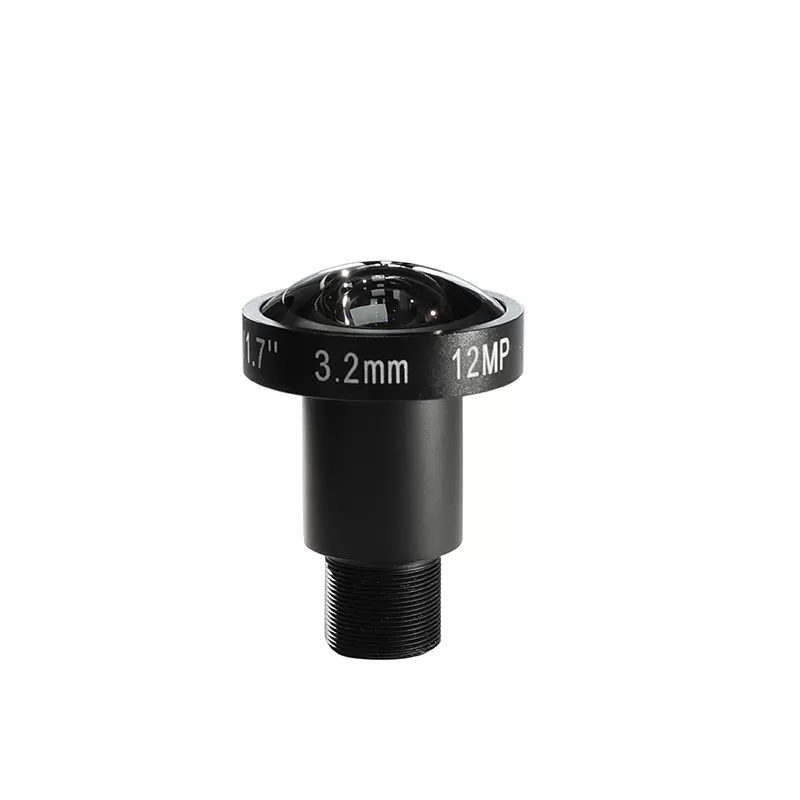
Wide-field optical systems inherently introduce geometric distortion due to the projection of a hemispherical or near-hemispherical scene onto a flat image sensor. This physical reality manifests primarily as barrel distortion, where straight lines bend outward from the center of the frame. Handling this optical phenomenon involves balancing physical lens geometry with downstream image signal processing (ISP).
Physical distortion mitigation relies on aspheric lens element design. Incorporating precision molded glass aspheres alters light ray angles smoothly across the element surface, preventing extreme ray bending at the optical margins. This structural design minimizes physical barrel distortion down to manageable limits before the light strikes the silicon sensor. Reducing the raw optical distortion directly reduces reliance on computational dewarping algorithms.
Algorithmic software correction stretches peripheral pixels to restore straight lines, which degrades local resolution and introduces blur near the edges. When optical pre-correction is prioritized during the initial wide angle surveillance camera lens design, the sensor captures a more uniform pixel density. Consequently, spatial detail remains intact, ensuring automated video analytics and license plate recognition algorithms operate on uncompressed physical data rather than computationally interpolated imagery.
Matching Image Sensor Parameters: CRA, Sensor Format, and Pixel Size
A frequent point of failure in vision system integration involves mismatching optical ray angles with the physical microlens array of the image sensor. The angle at which the chief ray strikes the edge of the active sensor area is designated as the Chief Ray Angle (CRA). Modern high-resolution sensors feature small pixel pitches, often below 2.0 micrometers, paired with integrated micro-lenses to funnel incoming light into each photodiode.
If the CRA of the selected wide angle surveillance camera lens significantly exceeds the vendor specification of the sensor microlenses, severe efficiency losses occur at the sensor perimeter. This optical misalignment leads to specific visual artifacts:
Relative Illumination Fall-Off (Vignetting): Significant darkening around the image periphery caused by light rays missing the light-sensitive area of the photodiode.
Color Crosstalk: Light rays striking adjacent pixel color filters at oblique angles, causing unnatural color shifts near the edges of the frame.
Signal-to-Noise Ratio (SNR) Degradation: Lower light gathering efficiency along the periphery forces higher gain amplification, introducing digital noise.
Selecting an optical system requires mapping the sensor optical format—such as 1/1.8 inch, 1/2.8 inch, or 1/1.2 inch—to the image circle diameter produced by the optics. The optical image circle must fully cover the diagonal measurement of the sensor matrix with zero mechanical vignetting while keeping the lens CRA matched within a tight threshold of the sensor CRA profile.
Thermal Stability and Passive Athermalization in Outdoor Optics
Surveillance systems operating in exposed environments encounter severe temperature fluctuations, ranging from sub-zero winter conditions to intense solar heating. Ambient thermal changes alter both the physical dimensions of the lens barrel assembly and the refractive index (dn/dT) of the optical glass elements. Uncompensated thermal variations shift the focal plane away from the sensor surface, degrading system resolution.
Mitigating focal drift requires a methodical optomechanical construction methodology known as passive athermalization. Rather than relying on power-consuming electromechanical heating elements or focus motors, passive athermalization pairs specific glass materials with housing metals that possess compensating thermal expansion coefficients.
Aluminum exhibits a relatively high thermal expansion rate, while brass and specialized stainless alloys expand at lower rates. By configuring optical spacers and element retainers crafted from complementary materials, mechanical movement offsets glass expansion and index alterations across temperatures spanning -40°C to +70°C. Maintaining focus stability without active motor control maximizes device reliability in remote or harsh operational field deployments.
NIR Focus Correction and Multi-Spectrum Anti-Reflective Coatings
24-hour visual monitoring relies heavily on Near-Infrared (NIR) illumination, typically operating at 850nm or 940nm wavelengths, to capture images in total darkness. Because optical glass refracts light based on wavelength, standard daylight-focused optics demonstrate noticeable chromatic focus shift when switching to infrared night mode. This shift leaves daytime crisp images blurred after infrared illuminators engage.
Elimination of night-mode defocus requires full day/night optical correction. This capability is engineered by integrating Extra-low Dispersion (ED) glass elements into the optical formula. ED glass exhibits specialized partial dispersion properties, allowing visual wavelengths (400nm to 700nm) and NIR wavelengths (850nm to 940nm) to converge onto the exact same focal plane.
Broadband Anti-Reflective (BBAR) coatings play a concurrent structural role. Multi-layer thin-film dielectric coatings deposited on glass surfaces reduce internal reflection across the visible and infrared spectrums. Unchecked internal reflections create stray light flare, ghosting, and contrast reduction when strong light sources, such as vehicle headlights or street lamps, appear in the field of view. Precise coating deposition guarantees maximum light throughput and high contrast image capture under dynamic lighting conditions.
Optomechanical Ruggedization for Harsh Operational Environments
Industrial imaging assemblies frequently endure continuous mechanical vibration, physical shock, and ingress risks from ambient dust and moisture. Securing the delicate optical elements inside a wide angle surveillance camera lens requires rigorous optomechanical housing design choices.
Precision-machined metal barrels, using aircraft-grade aluminum alloy or high-tensile brass, provide higher mechanical dimensional stability over time compared to molded plastic housings. Threaded element retaining rings locked with industrial-grade optical adhesives prevent individual glass elements from shifting center alignment during prolonged high-frequency vibration.
Ingress protection requires synthetic O-ring seals positioned at every joint, including front element seats, internal adjustment threads, and rear mount interfaces. Achieving IP67 or IP68 ratings demands microscopic tolerance control on sealing surfaces to prevent moisture ingress during rapid atmospheric pressure or temperature shifts. Front glass elements may also feature hydrophobic and hard carbon coatings to resist environmental chemical exposure, salt spray, and abrasive particulate contamination.
Custom Optical Design and Manufacturing Integration by Jinyuan
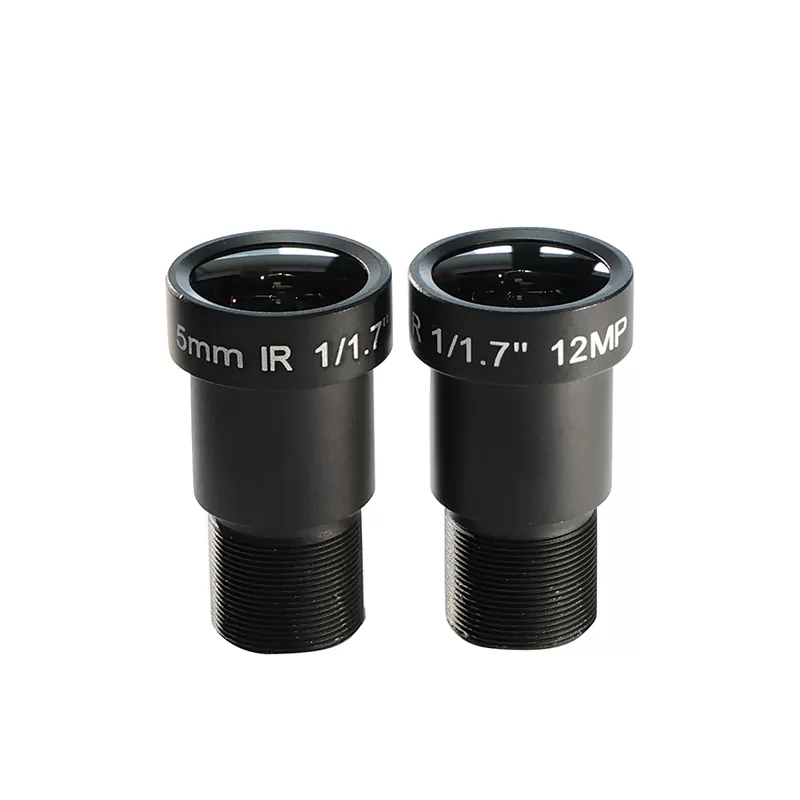
Off-the-shelf optical components often present performance compromises when integrating vision systems into proprietary enclosures, compact housing profiles, or non-standard sensor platforms. Custom optical engineering provides tailored parameters, including bespoke focal lengths, specialized optical CRA profiles, unique mechanical dimensions, and selective spectral bandpass coatings.
Jinyuan delivers comprehensive optical engineering services, covering complete optical design, optomechanical modeling, rapid prototyping, and scalable volume production. By managing the full lens development pipeline—from raw glass processing and precision spherical or aspheric surface polishing to thin-film vacuum deposition coating—Jinyuan maintains strict quality assurance over crucial optical metrics, including modulation transfer function (MTF), centration precision, and spatial distortion control.
Partnering with Jinyuan enables engineering teams to resolve spatial constraints and optical limitations early in product development cycles. Customized optomechanical solutions guarantee optimal alignment with specialized sensor architectures, providing robust visual performance across demanding commercial, industrial, and traffic monitoring applications.
Frequently Asked Questions
What is the functional difference between optical distortion and perspective distortion in wide-angle imaging?
Optical distortion is a physical aberration inherent to the lens construction, causing straight lines to curve outward (barrel distortion) or inward (pincushion distortion). Perspective distortion is a natural consequence of viewing geometry, where objects closer to the lens appear disproportionately larger than objects farther away. Optical distortion can be corrected through lens element design, whereas perspective distortion is governed entirely by camera placement relative to the subject.
How does a wide angle surveillance camera lens maintain sharpness under both daylight and infrared lighting?
Sharpness across day and night operational modes is achieved through daylight/infrared chromatic correction. By incorporating Extra-low Dispersion (ED) glass elements and multi-band optical coatings, the optical system forces visual light (400–700nm) and near-infrared light (850–940nm) to focus onto the identical image plane, preventing the focus shift common in uncorrected optics.
Why is Chief Ray Angle (CRA) alignment crucial when choosing optics for high-resolution sensors?
Image sensors feature tiny microlenses over each pixel photodiode designed to accept light within a specific angular window. If the exit angle of the rays coming from the lens (CRA) exceeds the acceptance angle of the sensor microlenses, light drops off sharply near the image edges. This mismatch causes severe vignetting, lower peripheral resolution, and localized color distortion.
How does passive athermalization protect optical performance in fluctuating temperature environments?
Passive athermalization utilizes a balanced combination of optical glass materials and mechanical housing metals with offsetting thermal expansion rates. As ambient temperatures shift glass refractive indices and element dimensions, the mechanical barrel expands or contracts at a matching rate, maintaining a stable distance between the optics and the sensor surface without requiring electric motors or heating elements.
Can high-resolution wide-angle optics reduce processing demands on camera hardware?
Yes. When an optical assembly limits physical barrel distortion and preserves uniform spatial resolution through precise aspheric element design, the camera image processor requires far less computational power to perform digital software dewarping. This hardware efficiency frees up internal processing capacity for edge AI tasks, continuous video analytics, and high-frame-rate encoding.
Initiate Your Custom Optical Engineering Project
Selecting the ideal optical configuration requires deep technical evaluation of spatial geometry, sensor characteristics, and mechanical constraints. The engineering team at Jinyuan is ready to analyze your visual application demands, provide comprehensive optical simulation reports, and deliver customized lens assemblies optimized for your production platforms.
To request technical datasheets, discuss customized wide angle surveillance camera lens specifications, or receive a competitive B2B inquiry quote, contact our engineering sales department directly via email at: clair-li@jylens.com / allen-zhang@jylens.com