
Selecting the right optic for an embedded vision system involves balancing size, weight, optical performance, and cost. For years, the M12 mount (S-mount) served as the standard choice for embedded cameras, automotive dash cams, and industrial inspection modules.
Modern machine vision systems now use larger image sensors with smaller pixels and higher resolutions. These sensors expose the mechanical and physical limits of standard M12 optics. When your system suffers from severe vignetting, low light starvation, or soft corners on a 1/1.8-inch sensor, an M12 lens will struggle to deliver results.
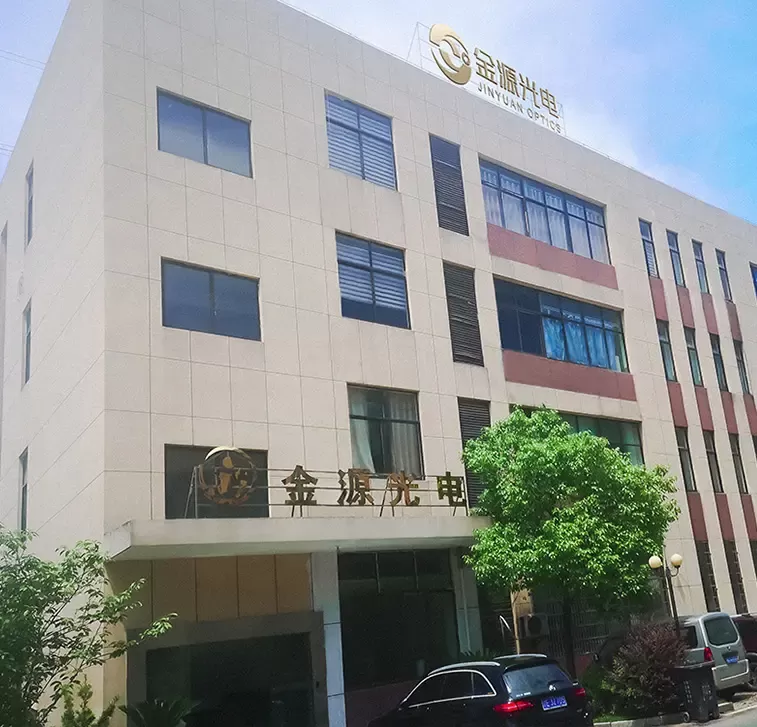
This is where the D14 Board Lens provides a practical alternative. Offering a slightly expanded barrel diameter, it bridges the gap between ultra-compact M12 lenses and bulkier C/CS-mount options. If your design team is hitting optical bottlenecks, optical manufacturers like Jinyuan supply advanced D14 platforms to help you achieve better light throughput and full-frame sharpness.
Need immediate engineering support or sample testing? Send an inquiry to our optical engineering team to discuss your custom sensor matching requirements.
Introduction: The Optical Trade-offs in Embedded Vision
The Reign and Reality of M12 (S-Mount) Lenses
The M12x0.5 thread standard gained popularity for straightforward reasons: it is compact, cost-effective, and supported by a massive global supply chain. For sensors ranging from 1/4-inch to 1/3-inch, a standard M12 lens provides adequate performance across robotics, basic surveillance, and consumer webcams.
Physics, however, cannot be bypassed. The 12mm outer barrel diameter restricts the clear aperture of the internal glass elements. As sensor makers pack 8 megapixels or 4K resolution into formats like 1/2-inch and 1/1.8-inch, the small throat diameter of the M12 standard causes optical compromises. Engineers frequently encounter chromatic aberrations, poor corner focus, and unacceptable light falloff.
Why D14 Board Lenses Are Stepping Up
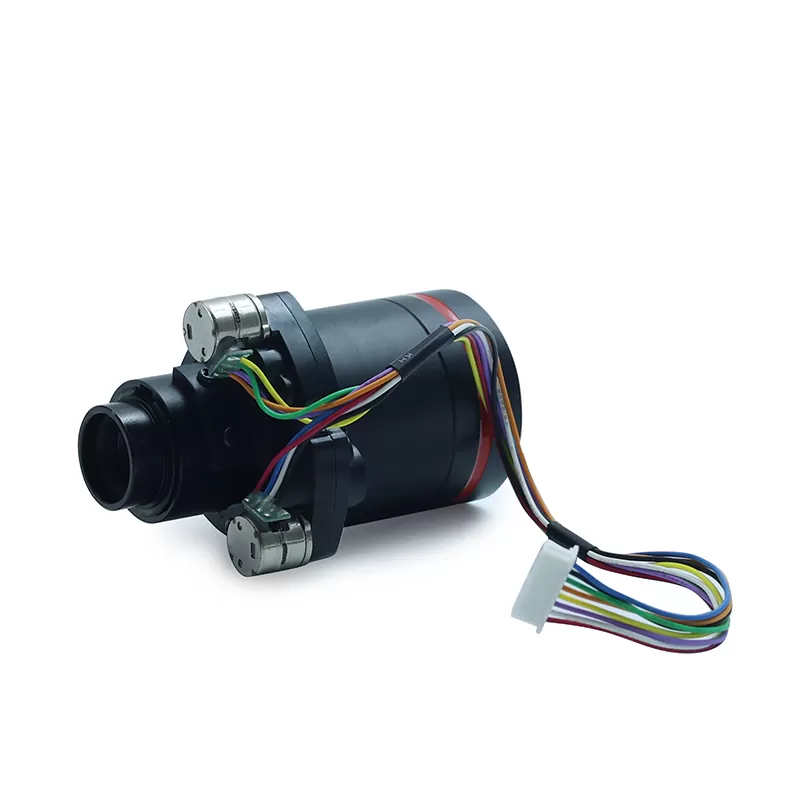
The D14 lens uses an M14x0.5 mounting thread. While a 2mm increase in diameter might sound trivial mechanically, it represents a substantial upgrade optically. It provides optical designers with approximately 36% more cross-sectional area inside the lens barrel.
This physical space allows for larger glass elements, steeper ray angles, and wider apertures. The D14 format has become the preferred standard for high-end automotive ADAS, intelligent traffic systems (ITS), drones, and low-light surveillance. It delivers high-resolution imagery without the size and weight penalties of C-mount lenses.
Core Optical Comparison: Where the D14 Board Lens Excels
When comparing a D14 Board Lens against an M12 counterpart, the mechanical dimensions dictate the optical performance ceiling. Below are the primary technical metrics where the D14 format shows distinct advantages.
Sensor Coverage and Vignetting (Image Circle Dynamics)
A major limitation of the M12 standard is its image circle diameter. While specialty M12 lenses can illuminate a 1/1.8-inch sensor (an 8.93mm diagonal), they often suffer from severe optical shading and mechanical vignetting at the edges.
Ray angles coming from the rear element of an M12 lens must bend aggressively to reach the corners of large format sensors. This steep Chief Ray Angle (CRA) creates two distinct problems:
- Relative Illumination Drop: The edges of your image appear significantly darker than the center, often losing over 50% of the light.
- CRA Mismatch: When the lens CRA exceeds the sensor microlens CRA acceptance limit, pixel crosstalk and color shading occur. Learn more about sensor microlens physics on the European Machine Vision Association (EMVA) standards page.
A D14 Board Lens comfortably projects an image circle exceeding 9.0mm to 10.0mm. The larger rear optical element allows light rays to strike the sensor pixels at shallower, more telecentric angles. This preserves corner illumination and prevents pixel crosstalk on modern Sony Pregius or Starvis sensors.
Aperture and Low-Light Sensitivity (F-Number Physics)
The optical speed of a lens depends on its focal length divided by its entrance pupil diameter. If your mechanical barrel restricts that entrance pupil, you cannot build a fast lens at moderate-to-long focal lengths.
Most M12 lenses designed for larger sensors hit an aperture barrier around F/2.0 to F/2.8. In low-light environments, this limited aperture starves the sensor, requiring higher analog gain and generating digital noise.
Because the D14 format accommodates wider front and internal glass elements, it allows for optical designs with large apertures, reaching down to F/1.0, F/1.2, or F/1.4. Moving from an F/2.0 M12 lens to an F/1.2 D14 lens yields almost a three-stop exposure advantage. This difference allows systems to capture sharp imagery in starlight conditions without needing auxiliary illumination.
Resolution and Edge-to-Edge Sharpness (MTF & Aberrations)
Modern machine vision sensors feature tiny pixels, often dropping down to 2.0 microns or 1.45 microns. Resolving details at this pixel pitch requires high Modulation Transfer Function (MTF) values across the entire field of view.
Engineers can reference optical design resources such as Edmund Optics Knowledge Center to study how pupil limits affect spatial frequency response. Under an M12 design, packaging multiple corrective elements to address optical aberrations is difficult due to space constraints.
The D14 barrel provides room for multi-element configurations (typically 6 to 8 glass elements) using anomalous dispersion and high-refractive-index glass. This volume helps optical engineers:
- Correct spherical aberration and coma at wide apertures.
- Suppress lateral and axial chromatic aberration (purple fringing on high-contrast edges).
- Maintain high contrast and resolving power past 150 to 200 line pairs per millimeter (lp/mm) from the center out to the corners.
Upgrade Decision Matrix: When Must You Shift to a D14 Board Lens?
Upgrading your optical platform requires retooling lens holders and adjusting your mechanical enclosure. You should only move away from M12 when your target application demands it. Here are four common scenarios where upgrading to D14 becomes necessary.
Scenario 1: Migrating to 1/1.8-inch and Larger Image Sensors
If your hardware team chooses modern sensors like the Sony IMX334, IMX485, or IMX678 to achieve 4K video, an M12 lens will compromise your system. The lens will restrict the sensor's perimeter, leading to soft focus and dark corners. Upgrading to a D14 Board Lens provides the edge-to-edge optical clarity needed to utilize the entire active pixel array.
Scenario 2: Demanding Starlight and Low-Light Conditions
In perimeter security, night navigation, and wildlife tracking, external illumination is not always an option. Relying on digital gain leads to motion blur and noisy images. A D14 lens with an aperture between F/1.0 and F/1.4 allows maximum photon throughput. This improves the signal-to-noise ratio (SNR) before the image signal processor (ISP) touches the raw data.
Scenario 3: Wide Field of View (FOV) Demands High Corner Sharpness
Ultra-wide lenses on an M12 mount tend to show significant barrel distortion and degraded corner sharpness. In edge-AI applications like automated license plate recognition (ALPR) or ADAS object classification, vehicles and pedestrians at the edges of the frame may lose definition. A D14 lens provides the optical volume required to control geometric distortion and retain spatial resolution across wide viewing angles.
Scenario 4: Complex Optical Filters and Mechanical Integration
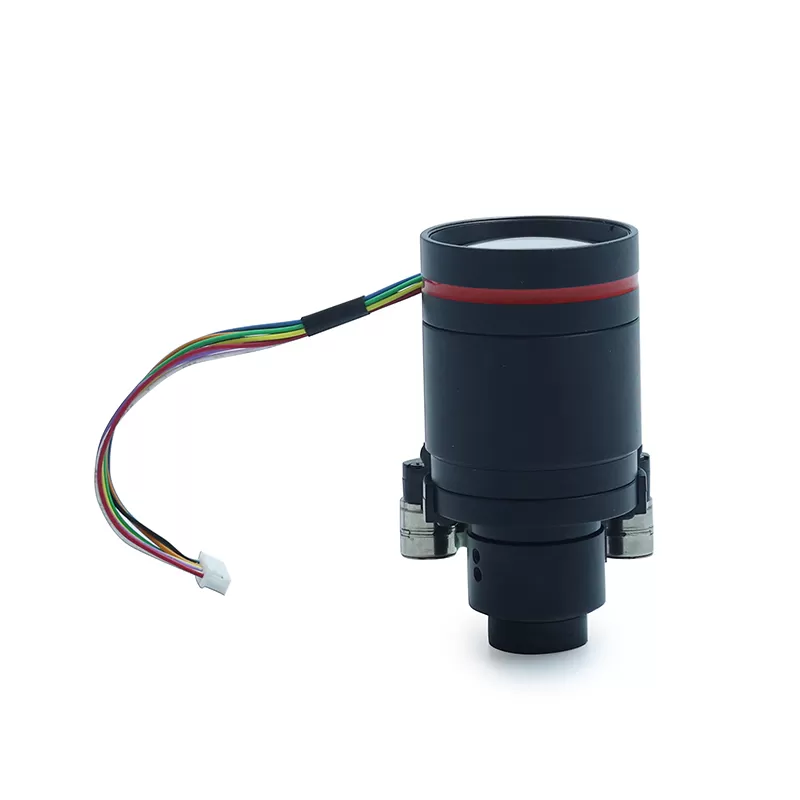
Advanced vision tasks often demand specialized internal hardware, such as dual-bandpass optical filters, automated mechanical IR-cut switches, or motorized focus mechanisms. Packaging these mechanisms inside an M12 envelope is difficult and often unreliable under vibration. Manufacturers like Jinyuan supply D14 assemblies engineered to house custom filter stacks and robust thermal-compensating spacers.
Engineering Trade-offs: What You Surrender with D14
A balanced engineering assessment requires reviewing both the benefits and the design compromises of the D14 form factor.
Mechanical Footprint and Barrel Constraints
The D14 holder requires a larger PCB keep-out zone than an M12 mount. The base footprint expands, and mounting screw distances increase. If you are developing an ultra-compact product like micro-drones or medical endoscopes, space limitations may still require using an M12 lens.
BOM Cost and Sourcing Ecosystem
The M12 ecosystem benefits from high manufacturing volumes. By contrast, a D14 Board Lens contains larger, precision-ground optical elements and tighter mechanical housings. As a result, unit costs are naturally higher. However, when compared to upgrading all the way to a C-mount lens and custom aluminum holder, the D14 remains a cost-effective intermediate step.
Thermal Stability, Weight, and Shock Resistance
Larger glass elements mean more moving mass during shock and vibration events. If your system operates in high-vibration industrial settings, you must specify robust metal barrels and locking mechanisms. Additionally, larger lens groups require careful mechanical design to prevent focus drift across operating temperatures between -40°C and +85°C.
Frequently Asked Questions (FAQ)
Q1: What are the exact mechanical thread dimensions of a D14 lens,
and will it fit into an M12 holder?
A1: A D14 lens uses an M14x0.5
metric thread (14mm diameter with a 0.5mm thread pitch). It is mechanically
incompatible with an M12 holder, which uses an M12x0.5 thread. Upgrading
requires a dedicated D14 lens mount with matching hole spacing on your sensor
PCB.
Q2: Can a D14 Board Lens work with onboard motorized auto-focus (AF)
modules?
A2: Yes. Many vision platforms integrate D14 optics with
voice coil motors (VCM) or stepper-motorized holders. These configurations
support motorized zoom and autofocus while maintaining stable optical alignment
under continuous motion.
Q3: Why not skip D14 entirely and use a standard C-mount or CS-mount
lens?
A3: C/CS lenses offer excellent optical performance, but they
are heavy, bulky, and more expensive. A C-mount lens usually features a 1-inch
(25.4mm) thread and a 17.526mm flange back distance, requiring a large
enclosure. The D14 lens gives you high optical performance in a compact
board-mount form factor suitable for space-constrained designs.
Q4: How does upgrading to a D14 lens impact my Image Signal Processor
(ISP) tuning?
A4: Upgrading to D14 typically simplifies ISP tuning.
The lens provides improved relative illumination and reduced CRA issues, which
lowers the need for aggressive digital Lens Shading Correction (LSC). This
reduces digital noise around image corners and improves overall color
accuracy.
Q5: Can I request custom optical coatings or IR-cut filters on D14
lenses?
A5: Yes. Standard configurations usually include either an
anti-reflective coating for visible light (with an IR-cut filter) or broadband
AR coatings for day/night setups (650nm/850nm/940nm passbands). Custom optical
coatings can also be tailored for specific industrial laser wavelengths or
specialized lighting environments.
Final Evaluation and Optical Recommendations
Choosing between an M12 mount and a D14 Board Lens comes down to a clear engineering trade-off: use M12 when mechanical size and unit cost are your main constraints, and choose D14 when your sensor size and low-light targets demand higher optical performance.
If you are upgrading your imaging sensor to 1/2-inch, 1/1.8-inch, or higher resolutions, relying on standard M12 lenses can bottleneck your hardware. Transitioning to a D14 lens provides the clear aperture, MTF performance, and sensor coverage required to get the most out of your camera system.
At Jinyuan, we design and produce optical solutions that address complex imaging problems. Our product lineup includes specialized D14 board-level optics built for clear imaging, wide apertures, and reliable thermal stability across harsh environments.
Take the next step in your system design: Contact the Jinyuan technical team today to request optical test reports, discuss your sensor specifications, or order evaluation samples for your prototypes.