
Every optical inspection system reaches a critical crossroad during development. System designers must decide whether to build around a standard catalog lens or design a tailor-made optical assembly from scratch.
Standard components offer convenience and low upfront expenses. However, forcing a stock component into a specialized setup can degrade edge resolution, limit throughput, or introduce geometric distortion that algorithms struggle to correct.
At Jinyuan, we frequently consult with vision architects facing this exact dilemma. If you need immediate assistance evaluating design trade-offs, contact our optical engineering team today to schedule a feasibility assessment for your project.
1. The Optical Crossroads in Machine Vision
An industrial imaging pipeline follows a strict rule: garbage in, garbage out. If the initial optical system fails to capture crisp contrast and accurate spatial geometry, no amount of downstream edge computing or neural network training can fully recover lost optical data.
Selecting the right machine vision lenses sets the performance ceiling for the entire inspection cell. Off-the-shelf (OTS) optics cover a broad spread of common applications, but they rely on compromise.
Catalog lenses must function reasonably well across arbitrary working distances and generic sensor formats. When your inspection system requires extreme measurement accuracy, specialized spectral bandwidths, or micro-packaging, compromise quickly turns into system failure.
2. Understanding Off-the-Shelf (OTS) Machine Vision Lenses
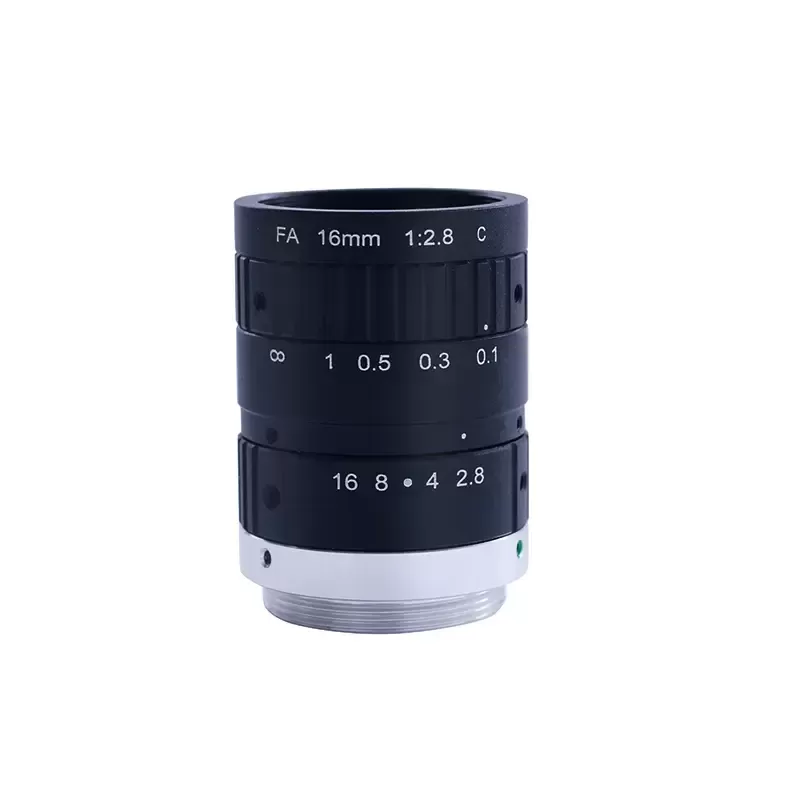
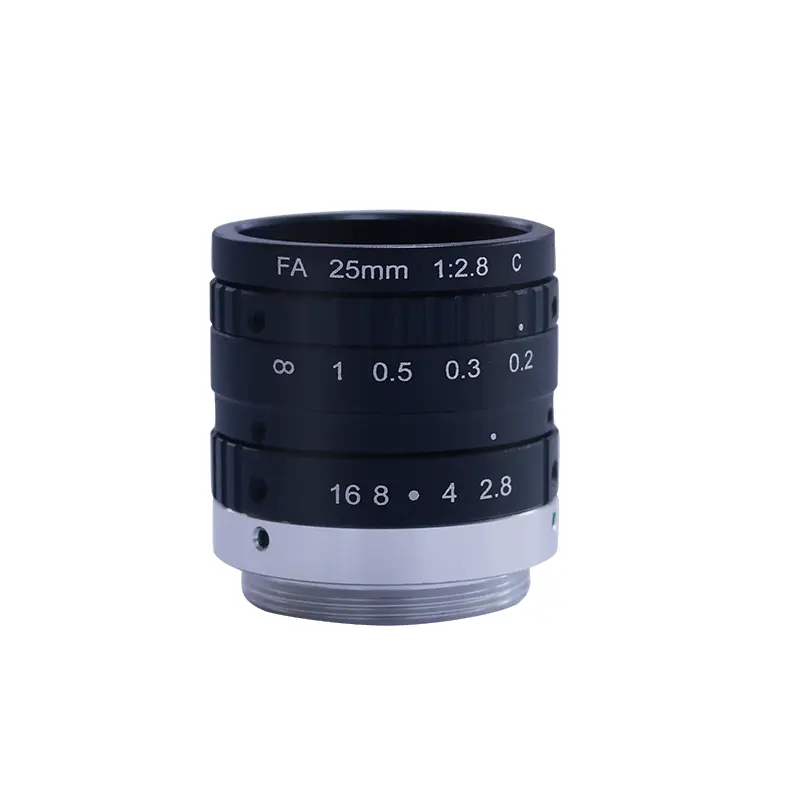
Off-the-shelf machine vision lenses represent the backbone of the industrial automation market. Optical component suppliers manufacture these mass-market assemblies in high batches, utilizing fixed mechanical barrels such as standard C-mount, CS-mount, or F-mount configurations.
For common factory floor deployments like barcode reading, pick-and-place robotics, and simple presence/absence verification, catalog products are the practical choice.
Advantages of OTS Lenses
- Zero Tooling Costs: You avoid upfront Non-Recurring Engineering (NRE) charges.
- Immediate Availability: You can purchase sample units immediately for rapid proof-of-concept testing.
- Field Serviceability: Standardized mounts make it easy to swap out damaged lenses on active production lines.
Inherent Limitations
Because catalog lenses target general industrial tasks, they feature mechanical and optical trade-offs:
- Suboptimal Optical Modulation: Resolution falls off sharply at the edges when paired with modern small-pixel, large-format CMOS sensors.
- Bulky Mechanics: Generic focus and aperture locking rings add unnecessary mass and volume to tight machine enclosures.
- Supply Instability: Manufacturers frequently alter internal glass types or discontinue catalog items without prior notice to the buyer.
3. The Capabilities of Custom Machine Vision Lenses
A custom machine vision lens represents a dedicated optical system designed to match one precise sensor, working distance, lighting environment, and mechanical envelope.
Engineers design bespoke optics from the ground up, picking specific glass melts, optimizing air gaps, and designing custom barrel geometry. This direct matching ensures peak performance across the target Field of View (FOV).
Optical engineers use platforms like Zemax or Code V to optimize the Modulation Transfer Function (MTF) specifically for your sensor's pixel pitch (such as 2.74 µm or 1.85 µm). Every optical surface pulls its weight, which eliminates unnecessary lens elements and boosts light transmission.
The main trade-offs involve upfront development expenses (NRE) and extended prototyping schedules. Precision grinding, coating, and assembly of custom optical elements typically take anywhere from 8 to 16 weeks before pilot testing begins.
4. The Decision Matrix: 5 Scenarios When Bespoke Optics Make Sense
Bespoke optics do not suit every project. However, certain technical roadblocks make custom optical engineering the only viable technical and economic route.
Scenario 1: Extreme Mechanical & Packaging Constraints
Modern medical diagnostic instruments, compact autonomous guided vehicles (AGVs), and robotic end-effectors do not have room for bulky C-mount lenses.
If your optical path must bend around internal motors, fit within an IP67-rated enclosure, or incorporate integrated fold mirrors, standard lenses fail. Bespoke optics integrate directly into your chassis, eliminating unnecessary metal housings and reducing mechanical vibration failure points.
Scenario 2: Non-Standard Wavelengths & Multispectral Illumination
Standard machine vision lenses feature anti-reflective (AR) coatings tuned strictly for the visible spectrum (400 nm to 700 nm). If your process monitors Short-Wave Infrared (SWIR 900 nm - 1700 nm), ultraviolet (UV), or combined broadband illumination, catalog glass often causes severe chromatic aberration and poor transmission.
A custom achromatic design balances dispersion across your specific wavelengths, keeping multi-spectral inspection clear without requiring software-based refocusing steps.
Scenario 3: Ultra-High Resolution & Near-Zero Distortion Requirements
Metrology and semiconductor inspection demand absolute geometric fidelity. Standard lenses often generate 1% to 3% optical distortion. Correcting this via image calibration algorithms stretches peripheral pixels, which destroys sub-micron measurement accuracy.
A custom telecentric or low-distortion lens design holds distortion below 0.05% across the entire image circle. This preserves raw image data, directly reducing system processing latency.
Scenario 4: Harsh Industrial & Environmental Demands
Standard industrial camera lenses use floating mechanical components, focus springs, and setscrews. Under continuous high-G shock and vibration—such as high-speed sorting machines or automotive production arms—standard mechanisms drift, throwing the target plane out of focus.
Jinyuan designs ruggedized custom optics with potted lens elements and fixed-aperture barrels. These assemblies resist optical shift in high-shock environments and maintain focus across wide temperature ranges (-40°C to +85°C) without mechanical drifting.
Scenario 5: High-Volume Cost Optimization & Intellectual Property Control
When system rollouts scale into thousands of units per year, catalog pricing erodes hardware margins. Paying retail margins for unused features—like adjustable irises or universal focus helicoids—wastes capital.
Designing a dedicated lens strip down excess glass elements and simplified mechanics, lowering bill-of-materials (BOM) costs at volume. In addition, proprietary optics create an intellectual property moat that prevents competitors from cloning your imaging subsystem.
5. OTS vs. Custom Machine Vision Lenses: A Head-to-Head Comparison
Review the primary engineering and procurement differences between standard off-the-shelf products and custom-designed optics below:
| Feature / Parameter | Off-the-Shelf (OTS) Lenses | Custom (Bespoke) Lenses |
|---|---|---|
| Initial Upfront Cost (NRE) | Zero to minimal catalog pricing | Moderate to high engineering & tooling investment |
| Prototyping Lead Time | Immediate (In-stock inventory) | 8 to 16 weeks for optical manufacturing |
| Per-Unit Cost at High Volume | High; fixed by standard catalog pricing tiers | Significantly lower BOM cost through optimized design |
| Optical Performance | Compromised for broad focal targets | Maximized MTF for a specific sensor & working distance |
| Mechanical Integration | Standard form factors (C/CS/F/M12) | Direct mechanical integration to application housing |
| Supply Continuity | Vulnerable to supplier EOL or revisions | Guaranteed life-cycle support, drawings follow ISO 10110 standards |
| IP Protection | None; easily purchased by competitors | Proprietary lens design secured by the OEM |
6. Calculating Total Cost of Ownership (TCO) and ROI
Many system designers mistakenly assume custom optics are always the more expensive path. Looking only at upfront NRE cost provides an incomplete view of overall financial impact.
Consider an automated electronics manufacturing line producing 200,000 components per month. A catalog lens with 0.8% edge distortion creates occasional measurement errors, triggering a false reject rate of 0.3%. Reworking those 600 components costs thousands in monthly engineering labor and lost capacity.
A custom-designed lens eliminates optical edge distortion, dropping false rejection rates to near zero. Pair that with a lower per-unit production cost at scale, and custom optics frequently recoup initial engineering investments within the first year of deployment.
Beyond defect rates, evaluate these hidden integration costs when using standard lenses:
- Engineering time spent developing software algorithms to correct optical barrel distortion.
- Adding complex external brackets to mount bulky catalog housings inside tight machines.
- Lost revenue caused by unplanned factory downtime when an off-the-shelf lens
manufacturer changes internal components without notice.
7. Finding the Right Balance for Your Vision System
The choice between catalog and custom optics rarely comes down to simple preference. It is a calculated engineering decision based on volume, space, resolution, and life cycle.
Use off-the-shelf lenses during early research, benchtop development, and initial proof-of-concept stages. If standard catalog optics reliably satisfy your throughput and precision goals within acceptable dimensions, use them.
However, when standard lenses force compromises on frame rates, physical packaging, inspection accuracy, or unit margins, moving to a custom design is the clear next step.
Jinyuan provides comprehensive optical design, prototyping, and volume manufacturing services for machine vision systems across the globe. Our engineering team reviews ray traces, MTF plots, and packaging constraints to match your sensor requirements without compromise.
Ready to evaluate your optical requirements? Request a technical feasibility review and quote from Jinyuan today to ensure your next-generation imaging system delivers optimum performance.
Frequently Asked Questions
Q1: What is the typical development timeline for custom machine vision lenses?
A1: Complete optical design and software simulation generally take 2 to 4 weeks. Following design sign-off, precision optical element grinding, multi-layer coating, mechanical barrel machining, and cleanroom assembly run roughly 8 to 12 weeks. Most teams receive verified optical prototypes within 10 to 16 weeks of project launch.
Q2: What is the typical minimum order quantity (MOQ) for bespoke machine vision lenses?
A2: Prototype runs rarely require large quantities; optical manufacturers typically deliver batches of 5 to 10 sample units for validation. For full-scale production, viable minimum order quantities normally start around 100 to 500 units annually to offset original tooling and NRE costs.
Q3: Can an existing off-the-shelf lens barrel be modified to save on custom design costs?
A3: Yes. This semi-custom engineering approach is common. If an existing optical prescription meets your image quality targets, engineers can repackage the optical elements into a customized, vibration-proof, or ultra-compact housing. This drastically reduces NRE expenses and shortens lead times.
Q4: How does a custom lens improve Modulation Transfer Function (MTF) performance?
A4: Catalog lenses split optimization across varied conjugate distances and cover glass thicknesses. Bespoke optics configure lens curvature, glass index properties, and air spaces to focus light precisely at one set working distance, sensor cover glass profile, and operating wavelength, yielding maximum contrast at the sensor's Nyquist limit.
Q5: When should our team transition from prototyping with OTS optics to designing a custom lens?
A5: The transition should occur once you freeze your sensor selection, system form factor, and working distance. Beginning custom optical engineering during the late design validation phase ensures clear mechanical boundaries, preventing expensive redesigns before pilot production begins.