
Modern Intelligent Transportation Systems (ITS) demand optical precision far beyond standard commercial security optics. When vehicles travel at speeds exceeding 200 km/h across multi-lane highways, a slight optical defect or focus drift directly causes automatic number plate recognition (ANPR) algorithms to fail. Deploying off-the-shelf closed-circuit television (CCTV) or standard factory automation (FA) lenses in traffic enforcement often results in missed plates, ghosted images under headlights, and thermal defocusing during seasonal shifts.
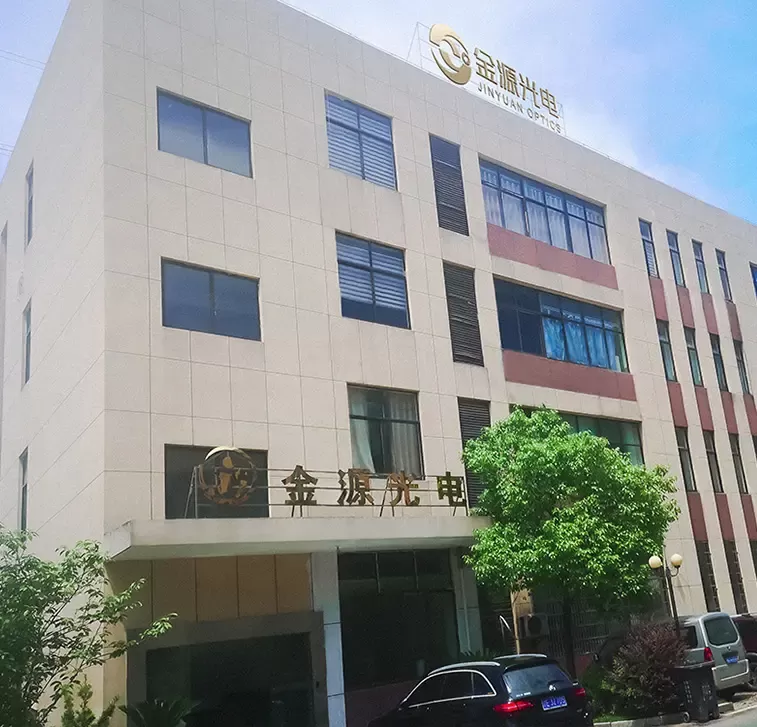
At Jinyuan, our optical engineering team designs purpose-built solutions to bridge the gap between complex sensor architectures and real-world outdoor road conditions. This guide examines the essential optical parameters hardware architects and system integrators must evaluate when specifying a high-performance ITS lens.
Why Standard CCTV and FA Lenses Fail in Modern ITS Deployments
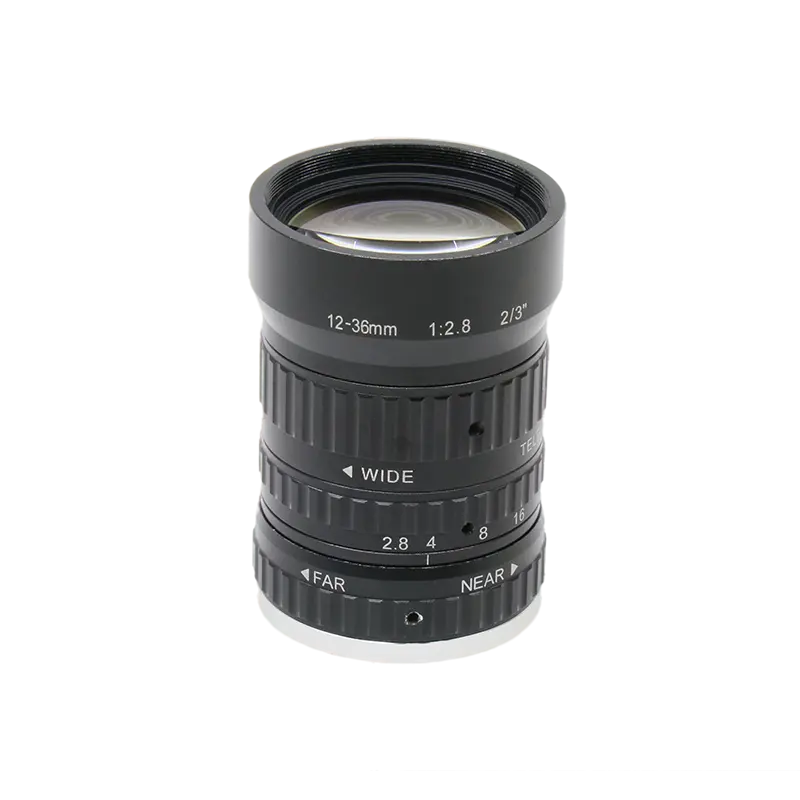
Standard security lenses prioritize low unit cost over optical precision. While suitable for indoor monitoring or basic surveillance, they degrade rapidly under harsh road conditions. ITS edge cameras operate in dynamic, high-stress environments characterized by:
Severe Thermal Swings: Roadside enclosures experience internal temperatures from -40°C in winter to +85°C in direct summer sunlight. Standard lenses suffer thermal expansion, pulling the focal plane away from the sensor surface.
High-Speed Motion Capture: Capturing moving plates across multiple lanes requires large-format global shutter sensors, rapid exposure times, and high spatial resolution across the entire field of view (FOV).
Extreme Dynamic Lighting: Headlight glare at night, blinding retro-reflections from license plates, and mixed visible-to-infrared illumination cause severe optical aberrations in generic optics.
A custom ITS lens solves these issues at the glass level, eliminating downstream algorithmic correction overhead and lowering system-level compute loads.
Critical Optical Metrics for Traffic Camera Engineers
Selecting the right optic requires a thorough analysis of how light interacts with both the optical elements and the underlying silicon sensor. Below are the primary optical parameters required for reliable automated traffic enforcement.
1. Sensor Matching, Image Circle, and CRA Compatibility
Modern traffic cameras utilize high-resolution, large-format global shutter CMOS sensors (such as 1/1.8", 2/3", 1", and 1.1" formats). An ITS lens must project an image circle that fully covers the sensor active area without vignetting or edge softness.
Equally critical is Chief Ray Angle (CRA) matching. Modern global shutter sensors feature micro-lenses with narrow acceptance angles. If the exit pupil of the lens creates a CRA that exceeds the micro-lens tolerance (often > 12°–15° toward the corners), the sensor suffers optical crosstalk, color shading, and severe peripheral light falloff. Custom optics ensure the lens CRA matches the silicon CRA profile within ±2° across the entire field.
2. Spatial Resolution and Edge-to-Center MTF Performance
Modulation Transfer Function (MTF) quantifies an optical system's ability to preserve contrast at specific spatial frequencies. A camera system running 4K or 12-megapixel sensors with pixel pitches below 3.45 μm requires exceptional high-frequency contrast.
While standard lenses may demonstrate 50% contrast at 50 lp/mm in the image center, their edge MTF frequently drops below 10% due to field curvature and astigmatism. In a three-lane ANPR setup, a vehicle in the outer lane maps directly to the sensor edge. An ITS lens must maintain a flat MTF response, retaining at least 30% to 40% contrast at 100 lp/mm or higher right to the extreme corner of the image circle.
3. Optical Distortion and TV Distortion Control
Traffic enforcement applications, such as average speed calculation, red-light tracking, and optical vehicle dimensioning, rely on strict spatial calibration. High barrel or pincushion distortion warps the coordinate grid.
Software-based geometric de-warping introduces interpolation artifacts, blurring alphanumeric plate characters and degrading neural network OCR confidence scores. High-precision traffic optics keep optical distortion strictly below -0.5% (or absolute TV distortion below 0.3%). This ensures raw image data remains geometrically true across all lanes without post-processing latency.
4. Day/Night Parfocality and Dual-Band IR Correction
Traffic cameras capture license plates in full visible spectrum daylight (400–700 nm) and switch to active pulsed infrared (850 nm or 940 nm) strobe illumination at night. Because different wavelengths refract at different angles through optical glass, conventional lenses suffer severe chromatic focal shifts.
To eliminate manual refocusing or motorized active correction mechanisms, an ITS lens integrates Extra-Low Dispersion (ED) and fluorite-type glass elements. True day/night parfocal optics bring 400 nm blue light and 940 nm infrared light to the exact same focal plane, maintaining sharp plate edge transitions 24/7.
5. Optical Athermalization (-40°C to +85°C)
Environmental thermal cycles cause optical glass elements to change their index of refraction ($dn/dT$) while aluminum barrel housings expand and contract. In a standard lens, a 20°C shift causes noticeable focal drift, rendering fine text unreadable.
Optical athermalization uses a balanced combination of optical elements with alternating positive and negative thermal coefficients paired with carefully chosen mechanical housing alloys (such as titanium, invar, or engineered aviation aluminum). This passive compensation maintains the back focal length (BFL) within the depth of focus across the entire industrial temperature range without requiring power-hungry mechanical motors.
6. Aperture Configuration and Dynamic P-Iris Control
A fast maximum aperture (such as F1.4 or F1.8) is necessary to gather sufficient photons during short microsecond exposure times at night. However, wide-open apertures reduce depth of field (DoF), making it difficult to keep vehicles across multiple staggered lanes in focus.
Standard DC-iris systems oscillate under rapid light changes and lack positional feedback. High-grade ITS cameras utilize P-Iris (Precise Iris) mechanisms. Working with camera firmware, the P-Iris stepper motor dynamically adjusts the physical aperture to maintain the sweet spot (typically between F2.8 and F4.0) where diffraction and aberrations are minimized, while preserving the depth of field necessary for multi-lane capture.
7. Anti-Reflective Coatings and Direct Glare Suppression
Nighttime traffic monitoring involves direct, high-intensity point light sources, specifically vehicle high beams pointing into the camera aperture. Poorly coated glass surfaces generate internal reflections, flare, and ghost images that obscure plate numbers and windshield driver-identification views.
Jinyuan integrates multi-layer broadband anti-reflective (BBAR) coatings on every optical boundary. These nanometer-precision dielectric layers deliver transmission rates above 98.5% per surface across the 400–950 nm band while actively canceling out internal stray light and ghosting artifacts.
ITS Application-Specific Lens Selection Matrix
Different traffic monitoring deployments require distinct optical tradeoffs. The following matrix outlines the recommended configurations based on common installation scenarios:
| Application Scenario | Key Optical Challenge | Recommended Focal Length | Aperture & Control | Core Optical Metric |
|---|---|---|---|---|
| High-Speed Checkpoint (ANPR) | Extreme target velocity, narrow field of view, distance > 30m | Telephoto (25mm to 50mm) | F1.4 - F1.8 / P-Iris | High MTF @ 120 lp/mm, Dual-Band 850nm IR Parfocal |
| Multi-Lane Electronic Police | Wide coverage (3-4 lanes), vehicle tracking, red light context | Wide to Mid (8mm to 16mm) | F1.6 - F2.0 / P-Iris | Ultra-low distortion (< -0.5%), CRA matching for 1" sensors |
| Free-Flow Tolling (ETC) | Close range, driver facial capture through tinted glass, zero ghosting | Standard (16mm to 35mm) | F1.4 Fixed / P-Iris | BBAR Anti-glare coating, high transmission @ 940nm |
| Mobile Traffic Enforcement | Vibration resistance, dynamic background, fluctuating focus | Varifocal / Fixed Ruggedized | F1.6 Rugged Iris | Passive Athermalization, Ruggedized Mechanical Locking |
The Custom Optical Engineering Pipeline
When off-the-shelf catalog products fail to meet system requirements, an engineering-driven customization process ensures the final optical assembly fits the exact mechanical envelope, environmental parameters, and sensor characteristics.
Phase 1: Optical & Mechanical Specification: Definition of working distance, capture width, sensor diagonal, CRA constraints, spectral band requirements, and housing envelope.
Phase 2: Ray Tracing & Simulation: Modeling optical performance in software like Zemax or Code V. Designers balance glass types to minimize chromatic aberration, maintain MTF across the entire field, and achieve passive thermal stability.
Phase 3: Optomechanical Housing Design: Engineering barrel tolerances down to micron levels. Threaded joints, athermal spacer rings, and internal anti-reflective baffles are modeled in 3D CAD.
Phase 4: Prototyping & Environmental Stress Testing: Assembling first-article prototypes followed by rigorous testing: MTF testing on optical benches, thermal shock cycling from -40°C to +85°C, and sine/random vibration screening.
Phase 5: High-Precision Batch Production: Cleanroom assembly using active alignment machines to center multi-element stacks precisely over the optical axis, followed by 100% MTF verification.
Frequently Asked Questions (FAQ)
Q1: Why does a standard FA lens lose sharpness when switching from daytime to night infrared strobe illumination?
A1: Standard lenses are corrected only for visible light (400–700 nm). Because glass has a different refractive index for longer wavelengths, switching to 850 nm or 940 nm infrared shifts the focal plane behind the image sensor. An optical design with dedicated IR correction uses specialized low-dispersion glass to force both visible and infrared wavelengths onto the exact same focal plane.
Q2: How does passive optical athermalization differ from active mechanical thermal compensation?
A2: Active thermal compensation relies on internal motors and temperature sensors to physically reposition glass elements as the housing heats up. Passive optical athermalization achieves the same stability without moving parts by balancing the thermal expansion of specific metal barrel materials against the optical glass power distribution. This approach increases field reliability and eliminates motor failure risks.
Q3: Why is a P-Iris preferred over a traditional DC-Auto Iris in automated license plate recognition?
A3: A DC-Auto Iris relies on analog voltage control and often closes too far in bright sunlight, causing optical diffraction that softens the image. A P-Iris uses a precise internal stepper motor controlled by camera firmware. It limits the aperture to an optimal working range, balancing illumination levels, diffraction limits, and depth of field across varying lighting conditions.
Q4: What problems occur if the lens Chief Ray Angle (CRA) does not match the image sensor CRA?
A4: When lens CRA exceeds the acceptance angle of the sensor micro-lenses, light striking the peripheral pixels enters at too steep an angle. This causes vignetting (dark corners), pixel crosstalk (color artifacts), and severe loss of peripheral edge sharpness, degrading plate recognition rates in outer traffic lanes.
Q5: What is the typical lead time and process for developing a custom ITS optic?
A5: Custom development typically takes 4 to 6 weeks for optical and mechanical design simulations, followed by 6 to 8 weeks for physical prototype manufacturing, coating, and assembly. Full environmental validation and pilot-run production are usually completed within 14 to 18 weeks from initial specification sign-off.
Partner with Jinyuan for Your Custom Optical Solutions
Building high-accuracy traffic enforcement systems requires an optical foundation that performs consistently in real-world road conditions. Generic lenses introduce system bottlenecks that software and algorithms cannot fully resolve. Custom-engineered ITS optics preserve image contrast, minimize optical distortion, and maintain stable focus across extreme temperature ranges.
Jinyuan designs and manufactures high-performance optical lenses tailored for ANPR, multi-lane electronic police, and high-speed highway enforcement cameras. Contact our engineering team today to review your sensor specifications, request evaluation samples, or initiate a custom optical design consultation for your next ITS platform deployment.