
In physical security and critical infrastructure monitoring, the optical chain determines the difference between actionable intelligence and unusable footage. While sensor technology advances rapidly, the lens remains the hardest performance constraint – especially under fluctuating light, temperature extremes, and long-term vibration. System integrators and procurement specialists often focus on megapixel ratings alone, ignoring the deeper optical engineering factors that cause focus drift, contrast loss, and night-to-day misregistration. Selecting a competent security application lens manufacturer requires understanding how glass formulations, mechanical tolerances, and anti-reflective coatings interact with modern high-sensitivity imagers. This article examines seven objective performance benchmarks, drawing from field failure data and ISO testing protocols, to help professional buyers qualify optical suppliers for surveillance, border security, and industrial monitoring.
1. The Hidden Failure Modes in Generic Security Lenses
Mass-produced lenses designed for consumer CCTV often introduce four reliability gaps when deployed in 24/7 security environments:
Thermal focus shift: Polycarbonate lens barrels expand at rates mismatched to glass elements, causing focus drift of 0.02mm per 10°C – enough to blur 8MP sensors completely.
IR cut shift without compensation: Many lenses focus visible light at a different plane than 850nm infrared. When the camera switches to night mode, images become severely defocused.
Flare and ghosting from low-grade AR coatings: Single-layer MgF₂ coatings produce 4-5% reflection per surface, creating veiling glare that reduces contrast in backlit scenes.
Environmental ingress through focus mechanisms: Unsealed helicoids allow moisture and dust to migrate into the optical path, permanently degrading resolution within months.
These failure modes directly impact evidence collection, perimeter breach detection, and automated video analytics. A professional security application lens manufacturer addresses each through controlled material science and precision assembly methods – not simply by adjusting production line parameters.
2. Optical Benchmarks: MTF, Distortion, and Relative Illumination
When qualifying lenses for security applications, three metrics provide quantifiable performance comparisons beyond pixel counts:
2.1 Modulation Transfer Function (MTF) at Nyquist Frequency
For a 4MP imager (2560×1440), the Nyquist limit is approximately 80 lp/mm. A surveillance-grade lens must maintain >0.4 MTF at 80 lp/mm across 70% of the image diagonal. Leading manufacturers, including Jinyuan, publish MTF plots measured at three field positions (center, 0.7 field, corner) for both sagittal and tangential orientations. Ask your security application lens manufacturer for MTF data measured at full aperture and stopped down to F/2.8 – many low-cost suppliers only simulate ideal designs.
2.2 TV Distortion and Keystone Effects
Security applications using multi-sensor panoramas require distortion < ±1%. Barrel distortion creates stitching mismatches in panoramic cameras, while pincushion deformation complicates automatic license plate recognition. A qualified supplier provides distortion maps measured at working distances of 5m, 15m, and 50m – because distortion varies with focus distance in floating-element designs.
2.3 Relative Illumination (Shading)
Corner shading reduces effective sensor sensitivity by up to 50% in wide-angle lenses. For 1/1.8” sensors used in low-light surveillance, relative illumination should remain above 65% at the corner. Professional security application lens manufacturer achieves this through optimized chief ray angle matching and aspherical element placement, not through digital post-correction which amplifies read noise.
3. IR Correction and Motorized Varifocal Precision
Day/night surveillance relies on lenses that maintain parfocality across visible and NIR bands (700-950nm). Traditional lenses suffer from chromatic focal shift: the same lens focuses green light at a different plane than 850nm IR. Advanced designs incorporate either:
Hybrid glass-plastic elements with anomalous dispersion to bring IR and visible foci together, or
Active IR correction via secondary floating group that shifts when IR-cut filter is removed.
For motorized varifocal lenses (2.7-13.5mm, 5-50mm), maintaining focus while zooming requires precision cam barrels with backlash under 0.01mm. Suppliers should provide step-response data showing settling time and repeatability after 50,000 zoom cycles. Jinyuan manufactures varifocal assemblies with stainless steel guide pins and PTFE-coated threads, achieving <5 arcmin of optical axis shift across full zoom range – a specification rarely documented by generic optical houses.
4. Environmental Hardening: Operating from -40°C to +85°C
Infrastructure cameras deployed outdoors face thermal cycles, solar loading, and condensation. Optical performance across -40°C to +85°C demands three specific engineering solutions:
Athermalized lens barrels using aluminum alloy (CTE ~23 ppm/°C) combined with glass elements (CTE ~8 ppm/°C) to maintain back focal distance within sensor depth of focus (±0.015mm).
Low-outgassing elastomer seals rated IP67/IP69K, with nitrogen purging ports for underwater or high-humidity installations.
Anti-fog inner surfaces treated with hydrophilic or hydrophobic nano-coatings to prevent condensation inside the optical path during rapid temperature drops.
A professional security application lens manufacturer will provide test reports from thermal chambers (ramp rate 2°C/min, dwell 2 hours at each extreme) and humidity cycling (95% RH, 40°C to 60°C). Do not accept generic “operating temperature” claims without accompanying MTF verification after thermal stress.
5. Custom Optical Solutions for Specialized Security Verticals
Off-the-shelf lenses often fail to match specific sensor formats (1/1.8”, 1/2”, 2/3”) or unique deployment constraints. Below are typical custom requirements that differentiate a true engineering partner from a box-mover:
5.1 Dual-Band Visible/SWIR Lenses for Covert Monitoring
Short-wave infrared (SWIR) imaging requires lenses corrected from 400nm to 1700nm, with anti-reflection coatings that suppress stray light in both bands. Custom designs can incorporate motorized filter wheels or liquid crystal tunable filters for spectral analysis.
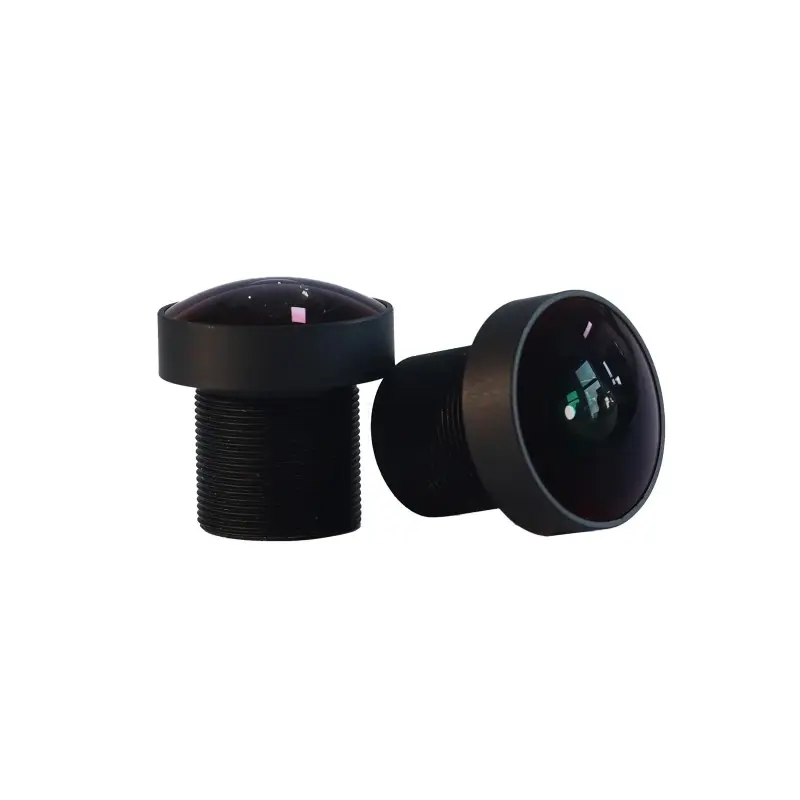
5.2 Extreme Wide-Angle (Fisheye) with De-warping Correction
360° panoramic cameras need lenses with >185° field of view and controlled barrel distortion that follows known polynomial models. A custom optical design can reduce residual distortion to <2%, minimizing de-warping artifacts in VMS software.
5.3 Explosion-Proof and Nuclear-Hardened Lens Assemblies
For petrochemical or radiological environments, lenses require sealed housings with glass thickness >10mm and anti-reflection bands matched to specific gamma radiation levels. Jinyuan has delivered such assemblies with fused silica elements and cerium-doped glass to prevent browning under continuous gamma exposure.
When evaluating a security application lens manufacturer for custom work, prioritize those with in-house optical design (Zemax, Code V), prototyping capabilities (diamond turning for aspheres), and environmental testing labs. Standardized “custom” services that only change mechanical mounts add little value.
6. Quality Assurance: From Element Inspection to Final Assembly
Repeatability across production batches requires statistical process control at three stages:
Single element testing: Interferometry for surface form error (≤0.5 fringe), spectrophotometry for coating transmission (spec tolerance ±1% absolute).
Sub-assembly centration: Auto-collimator measurements of tilt and decenter between groups (target <0.01mm and <3 arcminutes).
Final image quality audit: Automated MTF test stations that measure through-focus response at 5 field points, rejecting assemblies with peak MTF variation >0.1 across fields.
Ask your potential security application lens manufacturer for process capability indices (Cpk) for critical parameters like back focal length and modulation transfer function. A Cpk >1.33 indicates a controlled process; lower values predict field failures. Leading suppliers also perform accelerated life testing (ALT) – 500 hours at 85°C/85% RH, followed by 200 thermal shocks from -40°C to +85°C – with MTF re-measurement as pass/fail criteria.
7. Integration Support and Post-Sales Optical Validation
Complex security systems require more than a data sheet. Professional B2B buyers should demand:
Optical alignment fixtures that match the camera’s sensor tilt and shim requirements.
Lens shading correction tables in vendor-specific formats (Sony, Onsemi, etc.) for digital flat-field correction.
Field service tools including collimators and focus test charts for on-site recalibration after years of service.
Manufacturers like Jinyuan provide a full optical validation report with every shipment, including measured EFL, F-number, distortion numeric values, and relative illumination curve. This documentation streamlines system certification for government and defense contracts. The right security application lens manufacturer becomes an extended engineering partner, not just a component vendor.
Frequently Asked Questions (FAQ)
Q1: What is the real-world
difference between a 4MP and 8MP security lens when paired with a 4MP
sensor?
A1: An 8MP-rated lens typically has higher
MTF at 120 lp/mm, providing better contrast and edge sharpness even when used
with a 4MP sensor (which only resolves ~80 lp/mm). Overspecifying the lens
reduces aliasing artifacts and provides sharper fine details like license plate
characters. However, ensure the lens’s resolving power matches the pixel pitch;
an overly high-resolution lens may have very tight depth of field that
complicates focusing in dynamic scenes.
Q2: How can I verify if a lens
truly maintains focus during day-to-night IR
switching?
A2: Request a “through-focus IR shift”
measurement from the manufacturer. This graph shows the distance in microns
between the visible and NIR focal planes. Acceptable values are ≤½ of the
sensor’s depth of focus (e.g., for F/1.4 with 3.45µm pixels, DOF ~±8µm, total
shift ≤4µm). Also insist on video demonstration across a resolution chart
illuminated with 850nm LED, switching filters while recording. Many suppliers
claim correction but have measurable shift that becomes visible in analytics.
Q3: What minimum order quantities (MOQs) should I expect for custom
security lenses?
A3: For moderate mechanical
modifications (different barrel length, filter threads), MOQ can be 200-500
units. Full optical redesign (new glass types, aspheres) typically requires MOQ
of 1000-3000 units to amortize mold and tooling costs ($15k-$50k). Some
specialized manufacturers offer low-volume NRE with higher per-unit pricing for
prototypes and initial field trials. Always negotiate a development roadmap with
decreasing pricing over defined order volumes.
Q4: Are liquid lenses a
reliable alternative to motorized varifocal for security
applications?
A4: Liquid lenses (electrowetting)
provide fast focus without moving parts but currently suffer from temperature
sensitivity (response time changes with viscosity) and limited optical power
range. They are suitable for indoor, controlled-temperature applications like
license plate recognition at fixed distances. For outdoor security with wide
temperature swings and variable object distances, traditional motorized
varifocal remains more reliable. Hybrid designs (liquid lens for fine focus on a
moving stage) are emerging but lack long-term field data.
Q5: How does
the lens affect the effectiveness of AI-based video
analytics?
A5: AI models for person detection,
vehicle classification, and behavior analysis are trained on sharp images with
consistent contrast. Lenses with uncorrected lateral chromatic aberration
confuse edge detection algorithms, producing false positives or missed
detections. Similarly, veiling glare reduces the signal-to-noise ratio in shadow
regions, causing missed activations. A lens with >0.4 MTF at Nyquist, <1%
distortion, and >70% relative illumination at corners maximizes the detection
range of any analytics software. Investing in better optics directly reduces
false alarm rates in neural network inference.
Looking to specify high-reliability optical assemblies for your next surveillance or perimeter security project? Whether you need IR-corrected varifocal lenses, custom SWIR designs, or ruggedized housings for extreme climates, our engineering team provides full optical validation and integration support. Contact Jinyuan to request sample test reports, discuss your technical requirements, or schedule a consultation on MTF-based supplier qualification. Send your project specifications to our optical engineering desk – we respond with detailed performance simulations within 48 hours.
For technical inquiries and quotation: clair-li@jylens.com / allen-zhang@jylens.com | Request lens evaluation samples with full MTF and IR-shift measurement reports.