
For system integrators, camera makers, and inspection equipment manufacturers, the shift toward higher-resolution sensors (12 MP to 20 MP and beyond) has placed new demands on optical systems. The 1.1inch Large Format (diagonal ≈ 17.6 mm) is no longer a niche specification—it has become a baseline for applications that require wide field coverage, low noise, and exceptional edge-to-edge sharpness. However, designing lenses for this format introduces specific engineering trade-offs: larger image circles intensify aberrations, relative illumination drops at the periphery, and mechanical interfaces must be re-evaluated. This article breaks down the performance characteristics, real-world adoption barriers, and custom solutions available for 1.1inch Large Format optics, drawing on established optical principles and manufacturing practices from Jinyuan.
What Defines 1.1inch Large Format in Optical Engineering?
The term "optical format" originates from legacy vidicon tube diameters, not the actual sensor diagonal. A 1.1inch Large Format sensor has a physical diagonal of approximately 17.6 mm (active area typically 14.1 mm × 10.4 mm, depending on aspect ratio). For comparison, a 2/3" sensor diagonal is 11 mm, and a 1" format is 15.9 mm. The move to 1.1inch Large Format provides roughly 60% more photosensitive area than 1" sensors, which directly improves signal-to-noise ratio and dynamic range. However, the lens must project an image circle with a diameter of at least 18 mm to avoid vignetting. This larger image circle forces the optical designer to control off-axis aberrations (astigmatism, field curvature, lateral color) more rigorously than with smaller formats. Consequently, many standard C-mount lenses—limited to a maximum image circle of 16 mm—are incompatible with 1.1inch sensors. Engineers must select mounts like M35, M42, or F-mount, or request custom thread interfaces.
Engineering Demands and Solutions for 1.1inch Large Format Lenses
Resolution and MTF Matching
With pixel pitches shrinking to 2.0 µm to 3.45 µm on modern 1.1inch sensors (e.g., Sony IMX series, GMAX series), the required lens resolution exceeds 150 lp/mm at MTF > 0.3. To meet this, a 1.1inch Large Format lens must incorporate low-dispersion glass (e.g., S-FPL51, S-FPL53) and molded aspherical elements to correct spherical aberration and reduce the number of air-to-glass surfaces. Spherical aberration becomes more pronounced as the aperture size increases to maintain illumination. Aspherical surfaces also help manage coma and distortion across the full field. For custom projects, Jinyuan employs a hybrid design approach: two or three aspheric elements combined with apochromatic glass to achieve >0.4 contrast at 150 lp/mm across a 17.6 mm image circle.
Illumination Uniformity and Relative Illumination Control
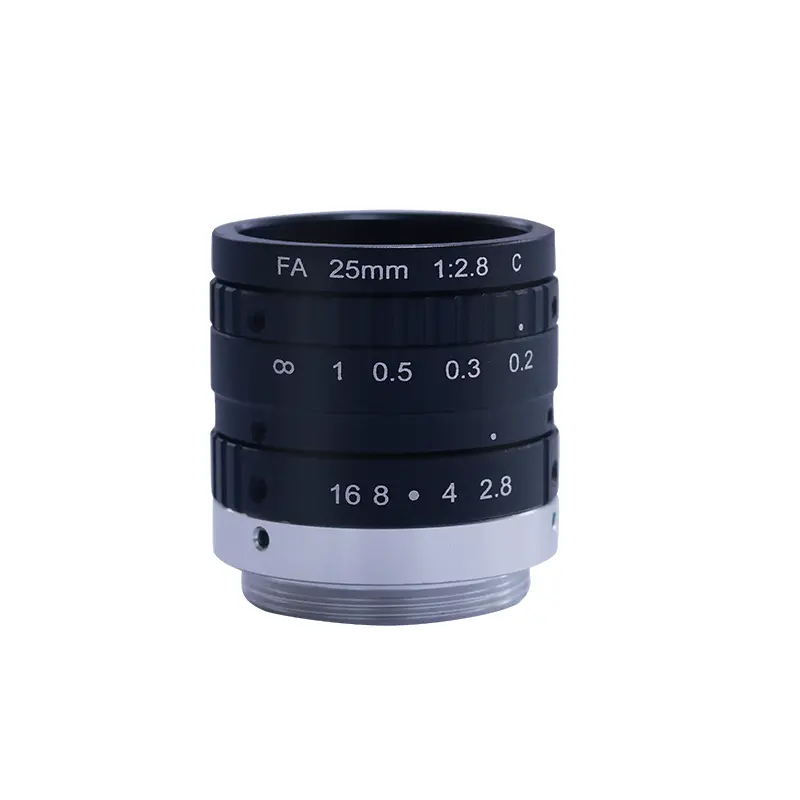
A common complaint with large-format optics is darkening at the corners (cos⁴ law fall-off). For a 1.1inch Large Format lens with a 25 mm focal length and f/2.8 aperture, the relative illumination at the corner can drop below 35% compared to the center. Solutions include:
Telecentric or quasi-telecentric designs: The chief ray angle (CRA) at the image plane is kept near 0°, reducing fall-off and improving measurement accuracy for metrology systems.
Graduated neutral density coatings or digital shading correction: While software correction exists, hardware-based uniformity ensures higher signal-to-noise in low-light industrial inspection.
Aspheric pupil positioning: Moving the stop location toward the front group equalizes illumination distribution. Jinyuan has successfully delivered 1.1inch Large Format f/2.0 lenses with corner-to-center illumination exceeding 75%.
Mechanical Integration and Mount Selection
Standard C-mount back focal distance (17.526 mm) restricts the use of 1.1inch sensors because the rear element must be very close to the image plane, leading to mechanical interference. Alternative interfaces such as M35-P0.75, M42 × 1, or custom bayonet mounts are preferred. For retrofit applications, Jinyuan offers adapter rings and custom flange tubes that maintain parfocal properties and offer locking mechanisms. Additionally, the larger lens barrel dimensions (typically 50 mm–65 mm diameter) require reinforced filter threads and heat-dissipation structures for continuous operation at elevated ambient temperatures (40 °C to 70 °C).
Key Industrial Applications Benefiting from 1.1inch Large Format
The 1.1inch Large Format is not chosen arbitrarily—it solves concrete problems in high-throughput and high-precision settings:
Flat Panel Display (FPD) and OLED Inspection: To detect sub-pixel defects on 8K displays, a large image circle allows a single camera to cover a 63 mm × 47 mm object field at 2.5 µm/pixel resolution, reducing scanning passes by 40% compared to 1" sensors.
Semiconductor Wafer Metrology: For dark-field inspection of 300 mm wafers, 1.1inch Large Format area scan cameras capture more dies per frame, improving throughput. The large format also reduces pixel crosstalk, essential for detecting sub-100 nm defects.
Medical Whole-Slide Imaging (WSI): Digital pathology scanners require both high resolution and large field of view. A 1.1inch sensor coupled with a high-NA objective delivers 0.25 µm/pixel across a 15 mm×15 mm tissue sample without stitching artifacts.
Intelligent Transportation Systems (ITS): Traffic monitoring at intersections demands high dynamic range and wide coverage. Using 1.1inch Large Format lenses with 12 MP sensors, one camera replaces two smaller-format units, simplifying installation and maintenance.
3D Laser Profiling: In triangulation systems, a larger image format increases the baseline measurement range and reduces shadowing effects on specular surfaces.
Overcoming Common Barriers in Adopting Large-Format Optics
Engineers often hesitate to specify 1.1inch Large Format due to perceived cost, size, and design complexity. Below are the actual challenges and proven methods to address them:
Barrier 1 – Higher optical element cost: Precision-molded aspheric lenses and ED glass increase unit price. However, using hybrid combinations (glass-molded aspheres with spherical lenses) can lower total element count from 9 to 6 pieces, offsetting material costs. Jinyuan’s design team uses this method to achieve f/2.4 designs at competitive volumes (500–5000 units/year).
Barrier 2 – Large front lens diameter and weight: A 1.1inch Large Format lens for a 35 mm focal length requires a clear aperture of ~25 mm. By reducing the number of groups and using high-index flints, the overall length can be kept under 65 mm, making it compatible with many existing gantry systems.
Barrier 3 – Thermal focus drift: Plastic barrels or mixed material selection (aluminum + Invar) cause focus shift under 10 °C–50 °C range. A passive athermalization design—matching expansion coefficients of the lens housing and the lens elements—can hold the image plane within the depth of focus. Jinyuan’s athermalized 1.1inch Large Format assemblies are validated for industrial environments.
Why Custom Engineering Beats Off-the-Shelf for 1.1inch Large Format
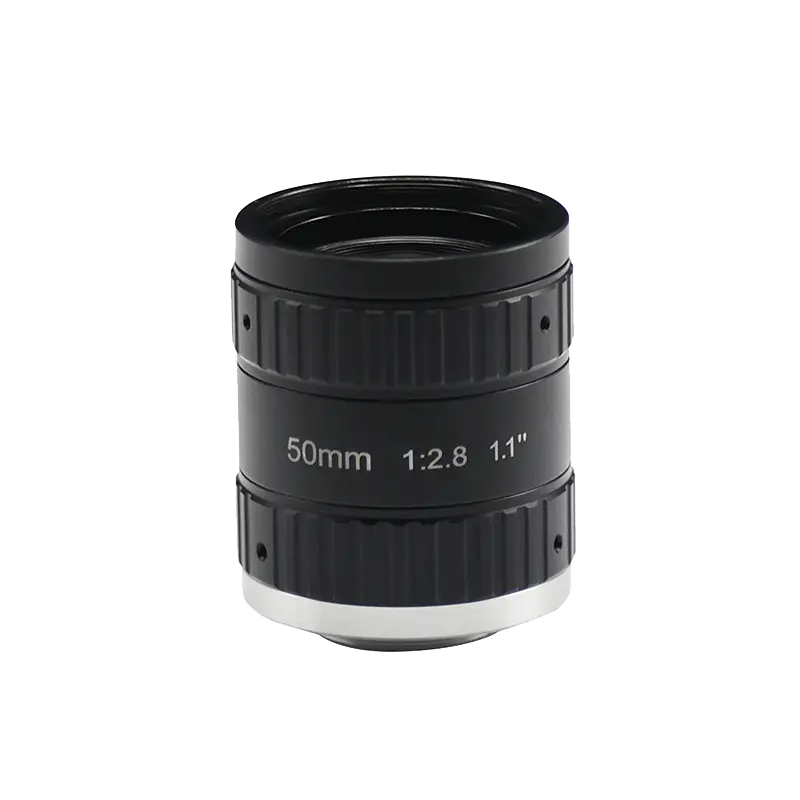
Standard large-format lenses are designed for general photography or wide-angle surveillance, not for the specific working distances, spectral bands, or magnification needs of industrial machines. A custom 1.1inch Large Format lens provides:
Spectral optimization: Coatings for 450 nm–700 nm (color inspection) or 850 nm–950 nm (near-IR sorting).
Fixed working distance with minimal distortion: Distortion below 0.05% for metrology, versus 1%–2% for catalog lenses.
Robust mechanical repeatability: Hard stops, locking focus rings, and sealed housings (IP5X or IP6X) for dusty production floors.
Jinyuan has delivered over 40 custom 1.1inch Large Format optical modules for semiconductor alignment, automated optical inspection (AOI), and remote sensing applications. Their process includes optical design (Zemax or Code V), tolerance analysis, prototyping (3–4 weeks), and volume production with MTF testing on Trioptics systems.
Frequently Asked Questions (FAQ) about 1.1inch Large Format Optics
Q1: Can a standard C-mount lens cover a 1.1inch sensor without
vignetting?
A1: Most C-mount lenses are designed
for a maximum image circle of 16 mm (for 1" sensors) or smaller. A 1.1inch Large
Format sensor requires an image circle of at least 18 mm. Using a standard
C-mount lens will result in heavy corner shading (vignetting) and loss of
effective resolution. You need lenses specifically marked as “1.1” compatible or
custom mounts like M35 or M42 with a larger barrel.
Q2: What is the typical MTF specification for a high-quality 1.1inch
Large Format lens?
A2: For industrial inspection
(12 MP sensor, 3.45 µm pixel pitch), a competent lens should exceed 40% contrast
at 145 lp/mm across 80% of the field. Premium designs achieve >50% contrast.
We measure MTF at three fields: center, 70% diagonal, and full corner. Jinyuan
provides full MTF test reports for each production batch.
Q3: Does using 1.1inch Large Format reduce the depth of field
compared to smaller sensors?
A3: For the same field
of view, f-number, and working distance, the depth of field is actually similar.
However, because you can use a longer focal length with a larger format to
achieve the same object coverage, the depth of field may decrease slightly. This
is often an advantage for separating defects from background clutter. If deep
DOF is required, we recommend telecentric designs or focus stacking.
Q4: How long does a custom 1.1inch Large Format lens project take
from specification to sample delivery?
A4: Typical
timeline: 1–2 weeks for feasibility and initial design, 3–4 weeks for mechanical
layout and tolerance analysis, 5–6 weeks for prototype tooling and assembly.
Delivery of 5–10 samples occurs around 10–12 weeks from final approval. Volume
production (100+ units) adds another 4 weeks. Jinyuan works with expedited
schedules for urgent machine vision projects.
Q5: Can I use a 1.1inch Large Format lens with a 1" sensor to get
better edge sharpness?
A5: Yes, over-formatting
(using a larger image circle than required) often improves edge sharpness
because you are only using the central, better-corrected portion of the field.
This also reduces relative illumination drop. Many system designers
intentionally pair a 1.1inch Large Format lens with a 1" sensor to achieve very
uniform performance and lower distortion.
Q6: What kind of coating is recommended for 1.1inch Large Format
lenses in harsh environments?
A6: For factories
with oil mist or abrasive dust, anti-reflection (AR) coatings with hardness >
3H (pencil hardness) and hydrophobic properties are recommended. Broadband AR
(400 nm–1000 nm) with average reflectivity <0.5% reduces stray light. Jinyuan
offers DLC (diamond-like carbon) coatings on outer surfaces for scratch
resistance.
Q7: Are there lightweight 1.1inch Large Format designs for
drone-based imaging?
A7: Yes, by replacing metal
barrels with carbon-fiber reinforced polymer (CFRP) and using hybrid
glass-plastic elements, the weight of a 25 mm focal length 1.1inch Large Format
lens can be kept under 90 g. Contact our engineering team for weight-optimized
designs.
Need a custom 1.1inch Large Format lens for your specific working distance, spectral band, or mechanical envelope? Jinyuan provides full-cycle optical design, prototyping, and volume manufacturing with MTF verification. Share your sensor model and performance targets with our optical engineers for a feasibility study and quote.
Request an Inquiry: Send your optical requirements to Jinyuan’s B2B support team via email or online form. We will respond within 24 hours with initial specifications and a design proposal.